

Key Takeaways
What Is a Route of Transmission?
Every infectious disease reaches a new host through a specific pathway called a route of transmission. Knowing these routes helps explain why some illnesses spread rapidly in crowds while others require close or prolonged contact - and why certain precautions work better than others for specific infections.
A pathogen - a bacterium, virus, fungus, or parasite - needs two things to cause an infection: a source (where it lives or originates) and a way to reach a susceptible person. That journey defines its transmission route. To understand what kinds of organisms are involved, see our guide on bacteria, viruses, fungi, and parasites.
80%
Of infections prevented by handwashing
The CDC estimates that handwashing alone can prevent about 80% of common infectious diseases.
1 in 6
Americans affected by foodborne illness annually
According to the CDC, approximately 48 million people in the U.S. experience foodborne illness each year.
700,000+
Deaths per year from vector-borne diseases globally
The World Health Organization estimates vector-borne diseases account for more than 700,000 deaths worldwide annually.
Respiratory Transmission: Droplets and Aerosols
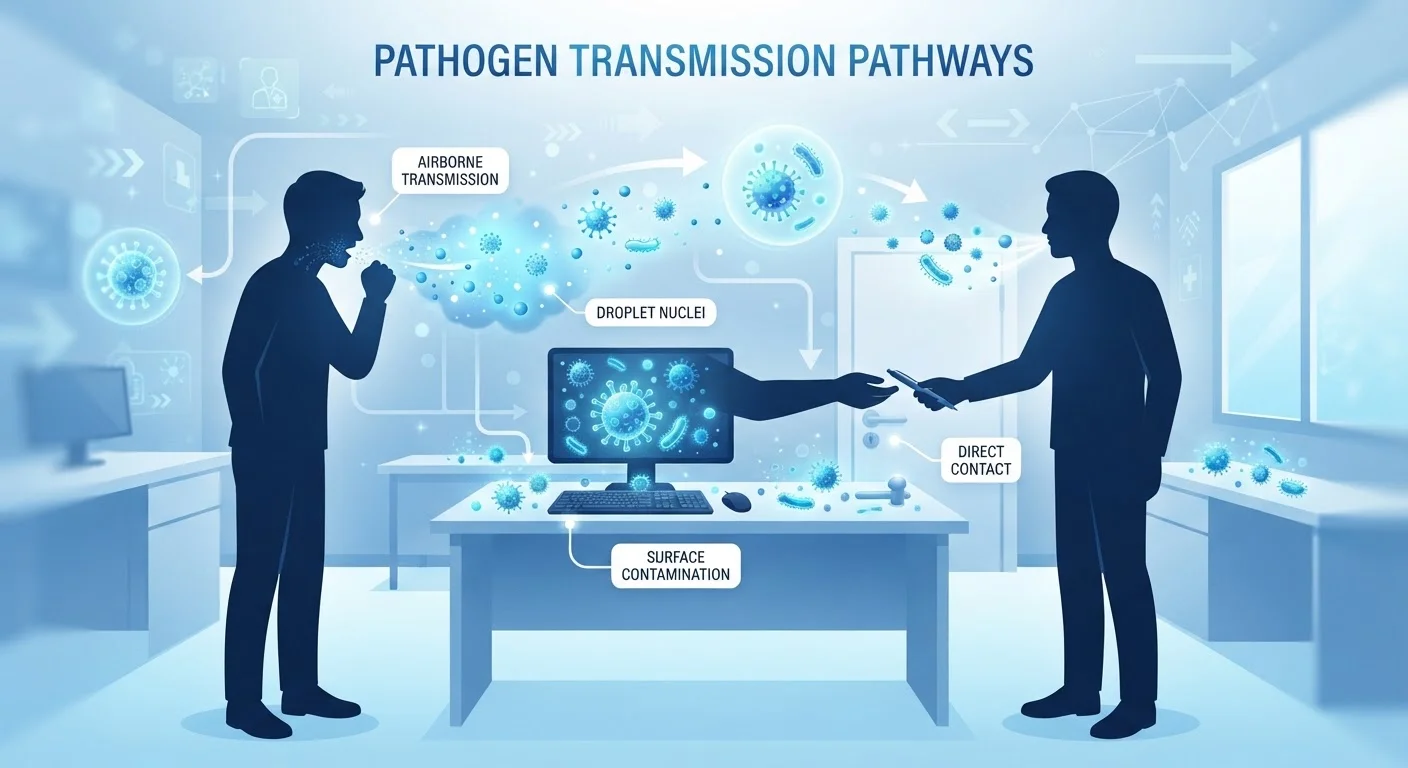
The most familiar transmission route is respiratory - pathogens released into the air when an infected person breathes, talks, coughs, or sneezes. Public health experts distinguish between two sub-types:
- Respiratory droplets: Larger particles (generally larger than 5 micrometers) that fall quickly to surfaces within roughly 3-6 feet of the source. Influenza and many common colds spread primarily this way.
- Aerosols (airborne transmission): Smaller particles that linger suspended in the air for minutes to hours and can travel farther. Measles and tuberculosis are classic examples; evidence also supports aerosol spread of SARS-CoV-2.
The practical difference matters: droplet precautions focus on distance and masks that filter large particles, while airborne precautions call for improved ventilation and higher-filtration respirators.
When an illness is circulating in your community, prioritize ventilating indoor spaces by opening windows or using air filtration - this targets aerosol spread that masks alone cannot fully address.
Research on COVID-19 and other respiratory pathogens has reinforced that improved air exchange significantly reduces airborne pathogen concentration in enclosed environments.
Avoid touching your face - especially your eyes, nose, and mouth - after handling shared objects or surfaces in public spaces, even if you can't wash your hands immediately.
Mucous membranes are key entry points for many pathogens; this habit breaks the chain of indirect contact transmission even when a sink isn't nearby.
Direct and Indirect Contact Transmission
Contact transmission is divided into two categories:
- Direct contact
- Physical transfer of a pathogen from one person to another - skin-to-skin touch, kissing, or sexual contact. Herpes simplex virus, scabies, and many sexually transmitted infections (STIs) move this way.
- Indirect contact (fomites)
- An infected person contaminates a surface or object - a doorknob, shared towel, or smartphone screen - and a second person touches it, then touches their eyes, nose, or mouth. Cold viruses and norovirus can survive on hard surfaces long enough to be transferred.
It is worth noting that surface-to-person spread varies considerably. Some organisms survive on fomites for hours; others die within minutes outside a host. Consistent hand hygiene remains the single most reliable defense against contact transmission.
Hand Hygiene Is Your Best Defense
Soap and water are more effective than hand sanitizer against certain pathogens, including norovirus and Clostridioides difficile. When hands are visibly soiled or you've potentially been exposed to these organisms, always choose soap and water over an alcohol-based sanitizer. Make it a habit after touching communal surfaces like elevator buttons, handrails, and public restroom fixtures.
Foodborne and Waterborne Transmission
When pathogens contaminate what we eat or drink, foodborne or waterborne illness results. Common culprits include Salmonella, E. coli, norovirus, and Cryptosporidium. Contamination can occur at any point - during growing, processing, storage, or preparation.
Waterborne transmission typically occurs when sewage contaminates drinking or recreational water supplies, a significant public health concern in areas without robust water treatment infrastructure. In high-income settings, foodborne outbreaks are more commonly traced to improper food handling or cross-contamination in commercial kitchens.
Don't Self-Diagnose Foodborne Illness
Symptoms like bloody diarrhea, a high fever, or signs of dehydration following a suspected foodborne exposure warrant prompt medical attention. Some foodborne illnesses - such as those caused by certain strains of E. coli - can lead to serious complications if not managed by a healthcare provider. Never assume severe symptoms will resolve on their own without evaluation.
Symptoms of foodborne illness - nausea, vomiting, diarrhea, and cramping - often appear hours to days after exposure. If symptoms are severe or prolonged, seeking medical evaluation is important rather than managing them at home without guidance.
Vector-Borne and Bloodborne Transmission
Some pathogens require a living intermediary - called a vector - to reach a human host. Mosquitoes transmit malaria, dengue, and West Nile virus; ticks carry Lyme disease and Rocky Mountain spotted fever. Vector-borne diseases are geographically clustered based on where the carrier insects or arachnids live and breed.
Bloodborne transmission occurs when infected blood or certain body fluids enter another person's bloodstream - through shared needles, needlestick injuries in healthcare settings, or from mother to child during pregnancy, childbirth, or breastfeeding. HIV and hepatitis B and C are the most recognized bloodborne pathogens. Understanding what happens once a pathogen is inside the body is explained in our article on what happens inside your body during an infection.
Practical Steps to Reduce Your Risk
Preventing transmission starts with matching precautions to the route most relevant for a given illness. Broadly, the following evidence-based steps offer protection across multiple transmission types:
- Wash hands thoroughly with soap and water for at least 20 seconds, especially before eating and after using the restroom or touching shared surfaces.
- Stay up to date with vaccinations, which build immunity before exposure occurs and reduce the severity of illness even when infection happens.
- Improve indoor ventilation to dilute airborne particles, particularly in crowded or enclosed spaces.
- Use appropriate protective equipment (masks, gloves) in situations where respiratory or contact exposure is elevated.
- Handle and store food safely: cook to recommended temperatures, refrigerate promptly, and avoid cross-contamination.
- Use insect repellent and protective clothing in areas where vector-borne diseases are prevalent.
Your immune system's own defenses are a critical partner in this process. For a plain-language explanation of how your body's defenses work, visit our guide on how the immune system works. For a deeper look at how bacterial and viral infections differ in treatment, see our article on viral vs. bacterial infections.
Seek Medical Advice for Symptoms
If you believe you have been exposed to a serious infectious disease or are experiencing symptoms such as high fever, difficulty breathing, rash, or persistent gastrointestinal distress, contact a healthcare professional promptly. Do not rely solely on general information to manage potentially serious illness. In an emergency, call 911 or go to the nearest emergency room.
This article is for general informational and educational purposes only and does not constitute medical advice. Always consult a qualified healthcare professional for guidance related to personal health concerns, symptoms, or medical decisions.