

Key Takeaways
Option A
Osteoarthritis (OA)
The wear-and-tear condition affecting millions of adults.
Best for: Understanding gradual joint breakdown related to age, weight, or prior injury.
Option B
Rheumatoid Arthritis (RA)
An autoimmune disease that attacks joints from the inside out.
Best for: Understanding immune-driven joint inflammation that can affect people at any age.
If you have joint pain that worsens with physical activity and improves with rest
Osteoarthritis (OA)
Activity-related pain that eases with rest is a hallmark of OA. Talk to your doctor about imaging and management options.
If your joints feel stiff and swollen for more than an hour after waking up
Rheumatoid Arthritis (RA)
Prolonged morning stiffness affecting both sides of the body is a common early sign of RA requiring prompt medical evaluation.
If you are over 60 and noticing gradual knee, hip, or hand pain
Osteoarthritis (OA)
OA is far more prevalent in older adults, particularly in weight-bearing joints. A physician can confirm diagnosis and guide lifestyle adjustments.
If you have joint pain accompanied by fatigue, low-grade fever, or other body-wide symptoms
Rheumatoid Arthritis (RA)
RA is a systemic disease with effects beyond the joints. These additional symptoms warrant urgent assessment by a rheumatologist.
What Sets These Two Conditions Apart?
Arthritis is not a single disease - it is an umbrella term covering more than 100 distinct conditions. Osteoarthritis (OA) and rheumatoid arthritis (RA) are the two most common, yet they differ fundamentally in cause, progression, and the populations they affect most.
Osteoarthritis is a degenerative joint disease. Cartilage - the cushioning tissue that protects the ends of bones - gradually wears away. As it thins, bones begin to rub against each other, producing pain, stiffness, and sometimes bone spurs. Risk increases with age, excess body weight, previous joint injuries, and repetitive joint stress. The CDC estimates that over 32 million adults in the United States live with OA.
Rheumatoid arthritis, by contrast, is an autoimmune condition. The immune system mistakenly attacks the synovium - the lining of the joints - triggering chronic inflammation that can damage bone and cartilage over time. RA affects approximately 1.5 million Americans and can develop at any age, including in children (where it is called juvenile idiopathic arthritis).
| Criterion | Osteoarthritis (OA) | Rheumatoid Arthritis (RA) |
|---|---|---|
| Underlying cause | Cartilage wear and degeneration | Autoimmune attack on joint lining |
| Typical age of onset | Usually over 50 | Any age, peak 30-60 |
| Joints commonly affected | Knees, hips, spine, hands | Wrists, hands, feet (symmetrically) |
| Morning stiffness | Less than 30 minutes | More than 1 hour |
| Systemic symptoms | Generally absent | Fatigue, fever, weight loss possible |
| Key diagnostic tools | X-ray, physical exam | Blood markers, imaging, physical exam |
| Primary treatment focus | Symptom relief, lifestyle changes | Immune suppression, preventing damage |
Recognizing the Symptoms
Both conditions cause joint pain, but the pattern and character of symptoms differ in clinically meaningful ways.
In OA, pain tends to worsen with physical activity and improve with rest. Affected joints - commonly the knees, hips, hands, and spine - may feel stiff after periods of inactivity, but this stiffness usually resolves within 30 minutes. Swelling, when present, is typically mild.
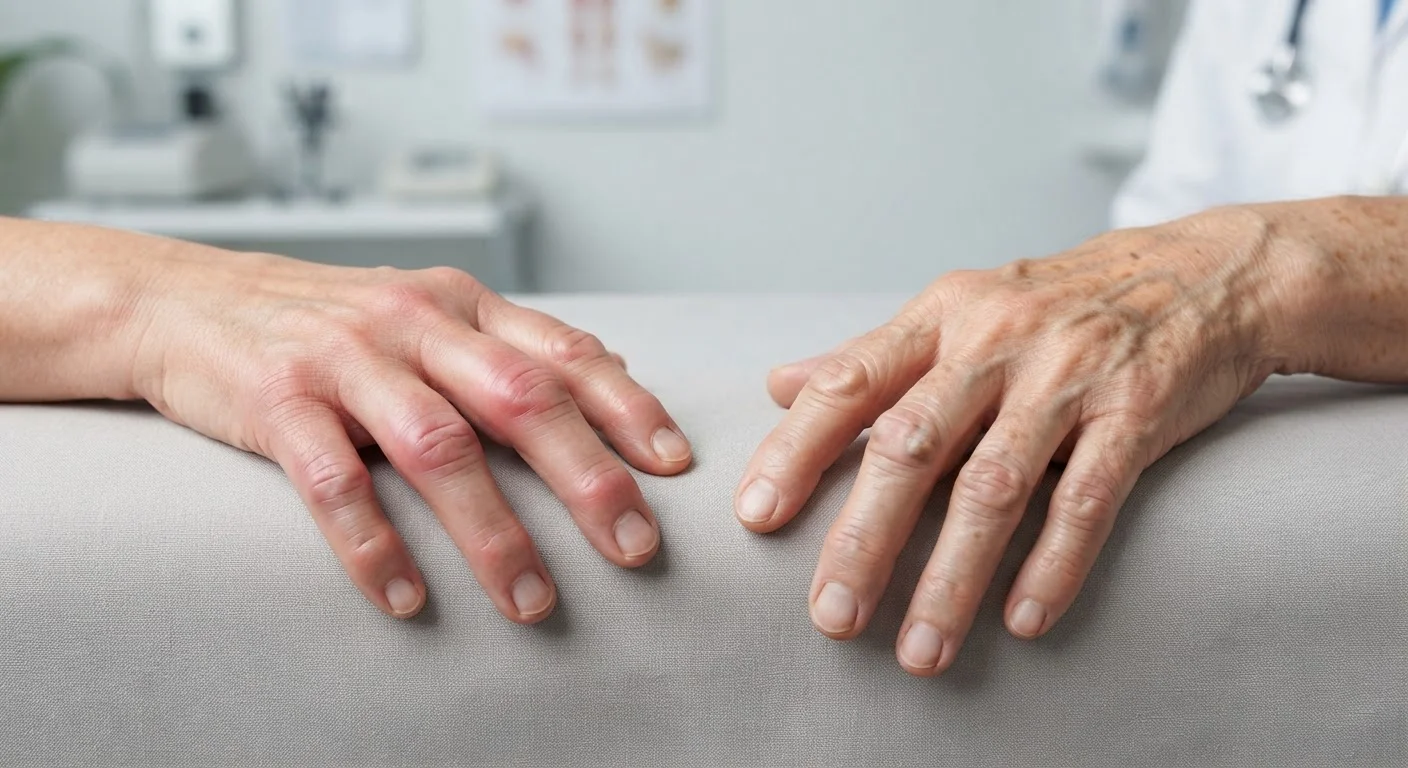
In RA, morning stiffness lasts longer - often more than an hour - and joints frequently appear warm, swollen, and tender. RA commonly affects joints symmetrically: if the left wrist is inflamed, the right wrist usually is too. Beyond the joints, RA can cause systemic symptoms including persistent fatigue, low-grade fever, and unexplained weight loss. Over time, untreated RA can lead to joint deformity.
32.5M
U.S. adults living with osteoarthritis
According to the Centers for Disease Control and Prevention (CDC), OA is the most common form of arthritis in the United States.
1.5M
Americans affected by rheumatoid arthritis
The Arthritis Foundation estimates approximately 1.5 million people in the U.S. have RA, with women affected at roughly twice the rate of men.
>1 hour
Morning stiffness duration in RA
Prolonged morning stiffness lasting more than one hour is a widely recognized clinical feature used to differentiate RA from other arthritis types.
This article is for informational purposes only and does not constitute medical advice. Always consult a qualified healthcare professional for diagnosis and treatment guidance.
Diagnosis and Management
Neither condition should be self-diagnosed. A physician - often a rheumatologist - will use a combination of physical examination, patient history, imaging (such as X-rays or MRI), and blood tests to reach a diagnosis.
For OA, blood tests are generally normal; diagnosis relies heavily on imaging to assess cartilage and joint space. For RA, specific blood markers such as rheumatoid factor (RF) and anti-cyclic citrullinated peptide (anti-CCP) antibodies, along with elevated inflammatory markers, help confirm the diagnosis.
Management strategies differ accordingly. OA care focuses on relieving symptoms and slowing progression through physical activity, weight management, physical therapy, and pain relief under medical supervision. RA management often involves disease-modifying antirheumatic drugs (DMARDs) to suppress immune activity and prevent joint damage - making early diagnosis especially critical. Lifestyle measures such as regular low-impact exercise and a balanced diet support wellbeing in both conditions.
When to See a Doctor
If you experience persistent joint pain, swelling, or stiffness lasting more than a few weeks, schedule an appointment with your primary care provider. Early evaluation is important because untreated RA, in particular, can lead to irreversible joint damage. Do not attempt to self-diagnose or self-treat based on symptoms alone.