

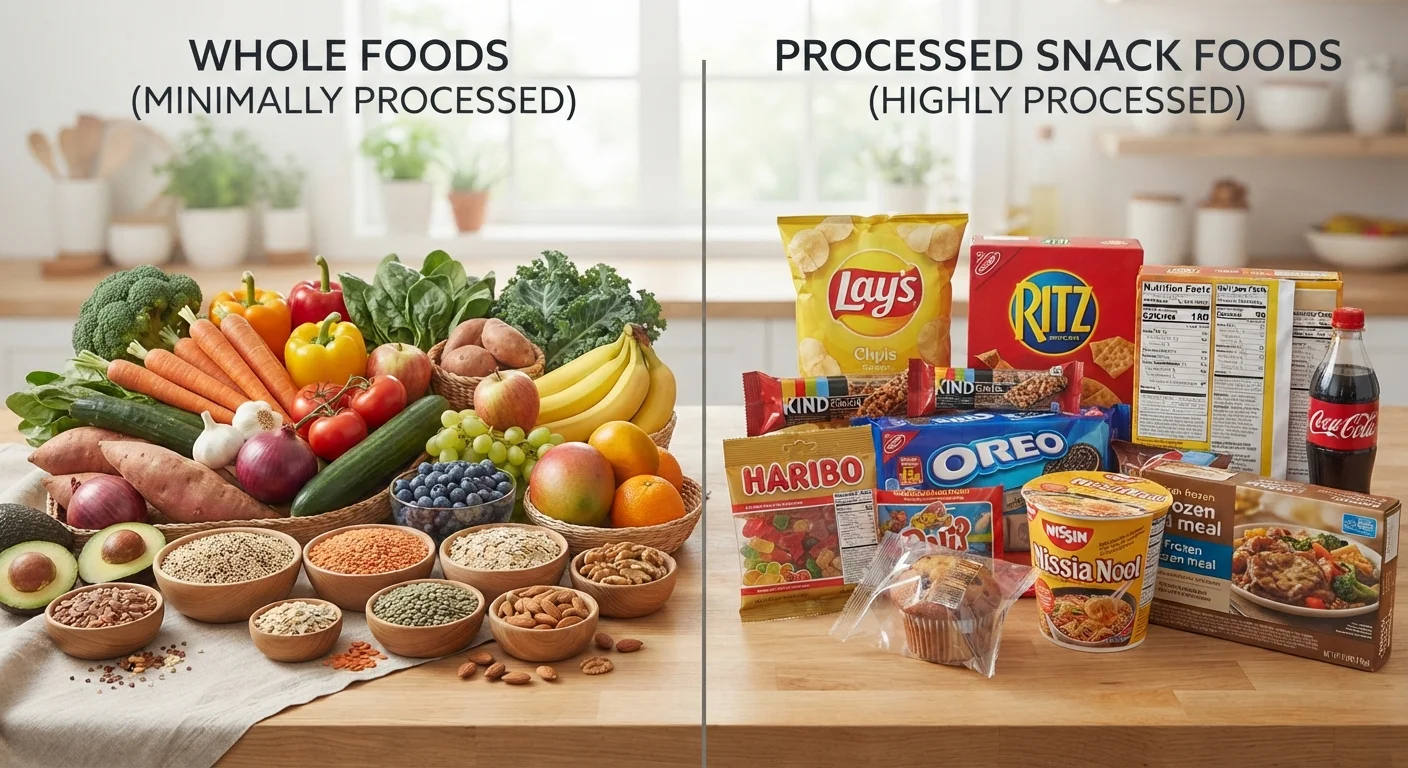
Key Takeaways
Option A
Whole Foods
Foods in their natural or minimally altered state.
Best for: Everyday eaters looking to build a nutrient-dense, balanced diet with simple, recognisable ingredients.
Option B
Ultra-Processed Foods
Industrially formulated products with many added ingredients.
Best for: Understanding what to limit — and why — when reading labels and making grocery decisions.
If you want to build a nutrient-rich everyday diet
Whole Foods
Whole foods provide fibre, vitamins, minerals, and beneficial plant compounds with minimal additives, supporting long-term health across most eating patterns.
If you are trying to understand what to reduce in your diet
Ultra-Processed Foods
Identifying and gradually reducing ultra-processed options is one of the most impactful dietary shifts supported by current nutrition research.
If convenience is a priority in your lifestyle
Whole Foods
Many whole foods — like fruit, nuts, eggs, and canned legumes — require no preparation and are just as convenient as packaged alternatives.
What Makes a Food 'Whole' or 'Ultra-Processed'?
The terms whole food and ultra-processed food are used frequently, but they mean something specific in nutrition science. Understanding the difference helps you read ingredient lists more confidently and make more informed choices — without overhauling your entire diet overnight.
A whole food is any food that is eaten close to its natural state with little or no industrial alteration. Think: an apple, a handful of oats, a raw chicken breast, or a handful of walnuts. These foods may be washed, cut, or cooked, but their fundamental composition hasn't been dramatically changed.
Ultra-processed foods, on the other hand, are a category defined by the NOVA classification — a research framework developed by Brazilian nutritionists to categorise foods by the extent and purpose of their processing. Ultra-processed products are industrially formulated using ingredients rarely found in home kitchens: emulsifiers, artificial flavours, hydrogenated oils, high-fructose corn syrup, and colour additives, among others. They are engineered for long shelf life, palatability, and convenience. Examples include many packaged snack cakes, instant noodles, soft drinks, and reconstituted meat products.
For a deeper look at how processing levels compare, see Whole Foods vs Processed Foods: Understanding the Real Difference.
| Criterion | Whole Foods | Ultra-Processed Foods |
|---|---|---|
| Ingredient list | One to a few recognisable ingredients | Long list with additives and industrial compounds |
| Level of processing | Minimal — washed, cut, or cooked | Extensively transformed by industrial methods |
| Fibre content | Naturally present and intact | Often removed; sometimes added back synthetically |
| Micronutrient density | High — vitamins and minerals retained | Lower — often depleted during processing |
| Additives | None or minimal | Emulsifiers, colours, artificial flavours common |
| Shelf life | Short to moderate | Extended by preservatives and formulation |
| Examples | Oats, apples, eggs, lentils, broccoli | Packaged snack cakes, instant noodles, soft drinks |
Why the Distinction Matters for Your Health
Nutrition researchers have found consistent associations between high ultra-processed food consumption and elevated risk of conditions including type 2 diabetes, cardiovascular disease, and obesity. These associations hold even after accounting for total calorie intake, suggesting it isn't only about calories — it's about what those calories are packaged with, or stripped of.
Whole foods tend to retain their natural fibre, micronutrients (vitamins and minerals), and phytochemicals (beneficial plant compounds). Ultra-processed foods often have these removed during manufacturing and may have synthetic versions added back. The resulting nutritional profile is meaningfully different, even when calorie counts look similar.
58%
Share of US calories from ultra-processed foods
Research published in the BMJ estimated that ultra-processed foods account for roughly 58% of total energy intake among US adults.
32%
Higher obesity risk with high ultra-processed intake
A large observational study found individuals with the highest ultra-processed food consumption had approximately 32% higher odds of obesity compared to those with the lowest intake.
That said, not all processing is harmful. Freezing vegetables, pasteurising milk, or canning beans are forms of processing that preserve nutritional value and support food safety. The concern is specifically with the ultra-processed category — products where the original food has been so extensively transformed that it barely resembles its source ingredient.
For guidance on spotting the difference on packaging, Nutrition Labels Decoded walks through how to read ingredient lists step by step.
Practical Steps: Shifting Toward More Whole Foods
You don't need a complete dietary overhaul to benefit from eating more whole foods. Small, consistent shifts tend to be more sustainable than dramatic restrictions. Here are some evidence-informed starting points:
- Swap one packaged snack per day for a whole-food alternative — fresh fruit, a boiled egg, or unsalted nuts are quick options.
- Check ingredient lists: a shorter list with recognisable ingredients is generally a sign of less processing.
- Cook one extra meal at home per week using simple whole ingredients — even basic combinations like rice, beans, and vegetables support a more balanced diet.
- Don't aim for perfection: a diet that includes some processed foods while being rich in whole foods overall is realistic and health-supportive for most adults.
Men may face specific challenges around food choices and convenience — the Whole Foods vs. Processed Foods for Men explores context-specific considerations in more detail.
If you are managing a chronic health condition, are pregnant, or are making significant dietary changes, please speak with a registered dietitian or your healthcare provider before adjusting your eating habits.
This article is for general informational and educational purposes only and does not constitute medical or dietary advice. Always consult a qualified healthcare professional for personalised guidance.