

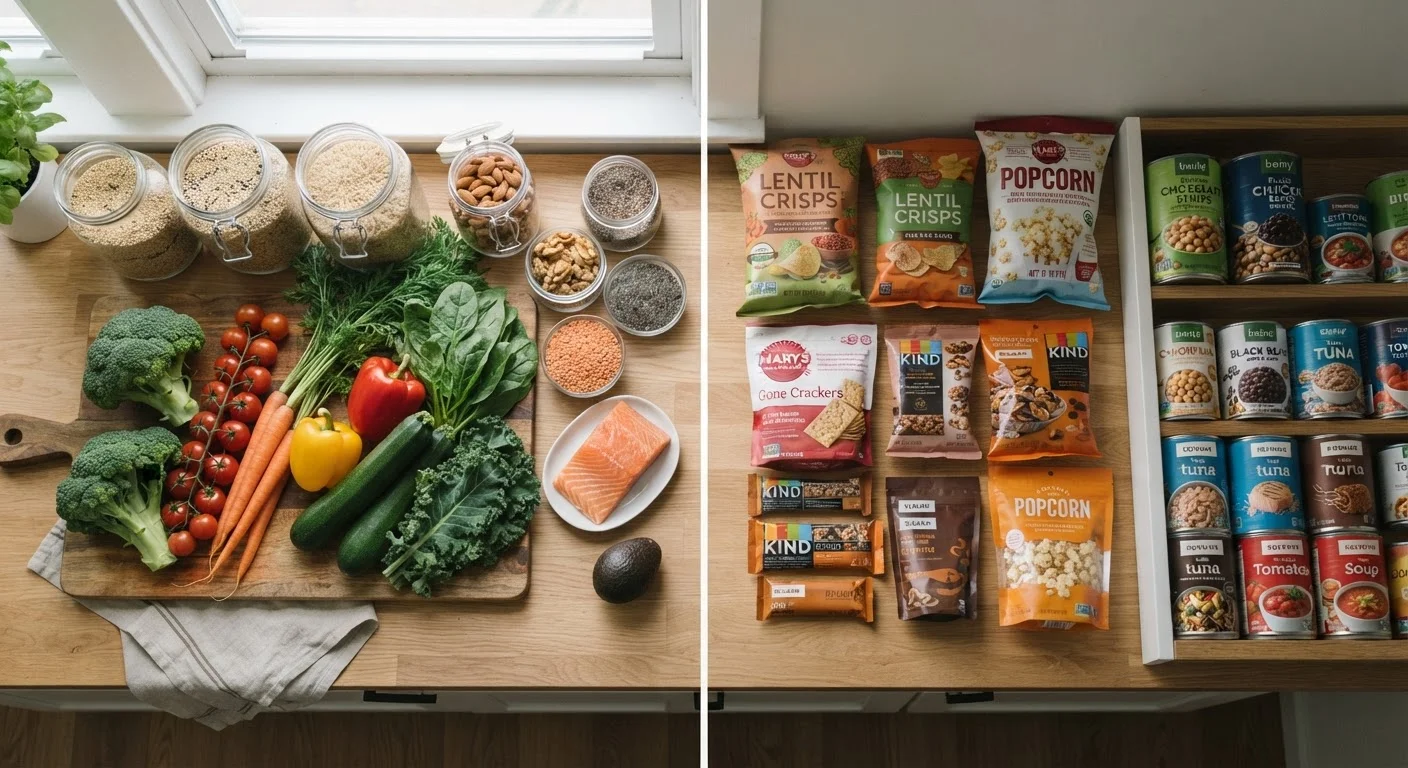
Key Takeaways
Option A
Whole Foods
The minimally altered, nutrient-dense foundation.
Best for: Men prioritising long-term metabolic health, hormonal balance, and sustained energy through diet.
Option B
Processed Foods
The convenient, varied category that ranges from benign to problematic.
Best for: Men managing busy schedules who rely on practical, shelf-stable, or fortified food options.
If your primary goal is cardiovascular health and blood pressure management
Whole Foods
Diets rich in whole foods — particularly vegetables, legumes, and whole grains — are consistently associated with lower blood pressure and reduced cardiovascular risk in research literature.
If you need quick, reliable nutrition on a demanding schedule
Processed Foods
Minimally processed options like plain canned fish, fortified cereals, or frozen edamame can fill real nutritional gaps when time and access are limited.
If you're managing weight or trying to reduce calorie-dense snacking
Whole Foods
Whole foods tend to be more satiating per calorie due to their fiber and protein content, making it easier to manage overall intake without strict calorie counting.
If you're an active man focused on muscle recovery and performance
Whole Foods
Whole food protein sources — eggs, legumes, lean meats — provide a broad spectrum of amino acids and co-nutrients that support recovery in ways isolated processed protein sources may not fully replicate.
If cost and food access are significant barriers in your daily life
Processed Foods
Affordable processed staples such as canned tomatoes, dried lentils, and frozen spinach remain nutritionally valuable and far more accessible than fresh whole food alternatives for many households.
What We Actually Mean by 'Whole' and 'Processed'
The terms "whole foods" and "processed foods" get used loosely, which creates genuine confusion. A whole food is one that has been minimally altered from its natural state — think oats, eggs, broccoli, or walnuts. A processed food is any product that has been changed from its original form before reaching you. That definition technically includes pasteurized milk, frozen peas, and canned chickpeas — none of which are nutritionally problematic.
Where the science draws a clearer distinction is between minimally processed foods and ultra-processed foods (UPFs). UPFs are industrial formulations containing ingredients rarely used in home cooking — such as emulsifiers, artificial flavors, and modified starches — designed primarily for palatability and shelf life. Examples include most packaged snack foods, sugary cereals, and fast-food items. This distinction between ultra-processed and whole foods is where most of the meaningful health evidence sits.
For men navigating nutrition, the takeaway is straightforward: the degree and nature of processing matters far more than whether something comes in a package.
| Criterion | Whole Foods | Processed Foods |
|---|---|---|
| Definition | Minimally altered from natural state | Modified before reaching the consumer |
| Fiber content | Generally high | Often reduced during processing |
| Micronutrient density | Broad, naturally occurring | Variable; may be added artificially |
| Additives & preservatives | Absent or minimal | Common in ultra-processed products |
| Convenience & shelf life | Lower; often requires preparation | High; ready-to-eat or long shelf life |
| Cardiovascular risk association | Lower risk with higher intake | UPFs linked to elevated risk |
| Cost accessibility | Varies; fresh produce can be costly | Often lower cost per serving |
| Satiety per calorie | Generally higher due to fiber and protein | Often lower; engineered for palatability |
How This Trade-Off Plays Out in Men's Health Specifically
Men's bodies face some specific nutritional pressures worth accounting for. Cardiovascular disease remains the leading cause of death in men across most developed countries, and dietary patterns are a well-established modifiable risk factor. Research consistently links higher intake of UPFs with elevated blood pressure, increased LDL cholesterol (commonly called "bad" cholesterol), and greater systemic inflammation — all of which raise cardiovascular risk.
57%
Of daily calories from ultra-processed foods
Studies of US dietary patterns suggest ultra-processed foods contribute more than half of total daily calorie intake for many American adults.
12%
Higher all-cause mortality risk
Research published in JAMA Internal Medicine found that higher ultra-processed food consumption was associated with increased all-cause mortality risk in large observational cohorts.
10+ years
Cardiovascular risk accumulation window
Dietary patterns across a decade or more are most predictive of cardiovascular outcomes in men, according to long-running cohort studies such as the Health Professionals Follow-up Study.
Testosterone and hormonal health are also relevant. Some research suggests that diets high in refined carbohydrates and trans fats — common features of highly processed foods — may negatively affect testosterone levels over time, though this remains an area of active investigation. Diets rich in zinc, healthy fats, and varied micronutrients found in whole foods appear to support healthier hormonal environments. That said, no single food or category guarantees any hormonal outcome.
Muscle mass and body composition are additional factors. Whole food protein sources — including eggs, legumes, poultry, and fatty fish — tend to deliver a richer amino acid profile alongside beneficial co-nutrients like B vitamins and omega-3 fatty acids. Processed protein products can be convenient but vary significantly in overall nutritional value. For a broader view of how diet fits men's health at every life stage, the Men's Nutrition end-to-end resource provides comprehensive context.
Finding a Workable Balance in Practice
Rigidly eliminating all processed food is neither realistic nor necessary for most men. A more useful framework is thinking about your overall dietary pattern rather than judging individual items in isolation. If the majority of your meals are built around whole or minimally processed ingredients — vegetables, whole grains, lean proteins, legumes, fruit, and nuts — then occasional ultra-processed foods carry much less weight.
Practically, a few shifts tend to make the biggest difference:
- Use minimally processed staples as your default: canned fish, frozen vegetables, plain Greek yogurt, and dried legumes are all processed but nutritionally strong.
- Read ingredient lists rather than relying on front-of-pack health claims. A short, recognisable ingredient list generally signals less processing.
- Build meals around one whole food anchor — a grain, a protein, a vegetable — and add convenience items around it rather than the reverse.
If you're also navigating questions about nutrient gaps, it's worth understanding how whole foods compare to fortified alternatives — see the comparison of whole foods vs. fortified foods for a nuanced breakdown. And if dietary pattern questions extend to plant-based eating, the plant-based vs. omnivorous diet trade-offs article offers a balanced perspective.
Not All Processing Is Equal — A Quick Reference
Frozen spinach, canned salmon, and plain rolled oats are all processed foods by definition, yet they retain most of their original nutritional value. The most health-relevant distinctions involve ultra-processed products with long additive lists and low nutrient density. When in doubt, comparing ingredient lists rather than packaging labels gives a clearer picture. For a deeper look at what separates these categories, see the whole foods vs. processed foods breakdown.
This article is for general informational purposes only and does not constitute medical or dietary advice. Speak with a qualified healthcare provider or registered dietitian before making significant changes to your diet, especially if you have existing health conditions.