

Key Takeaways
Option A
Innate Immunity
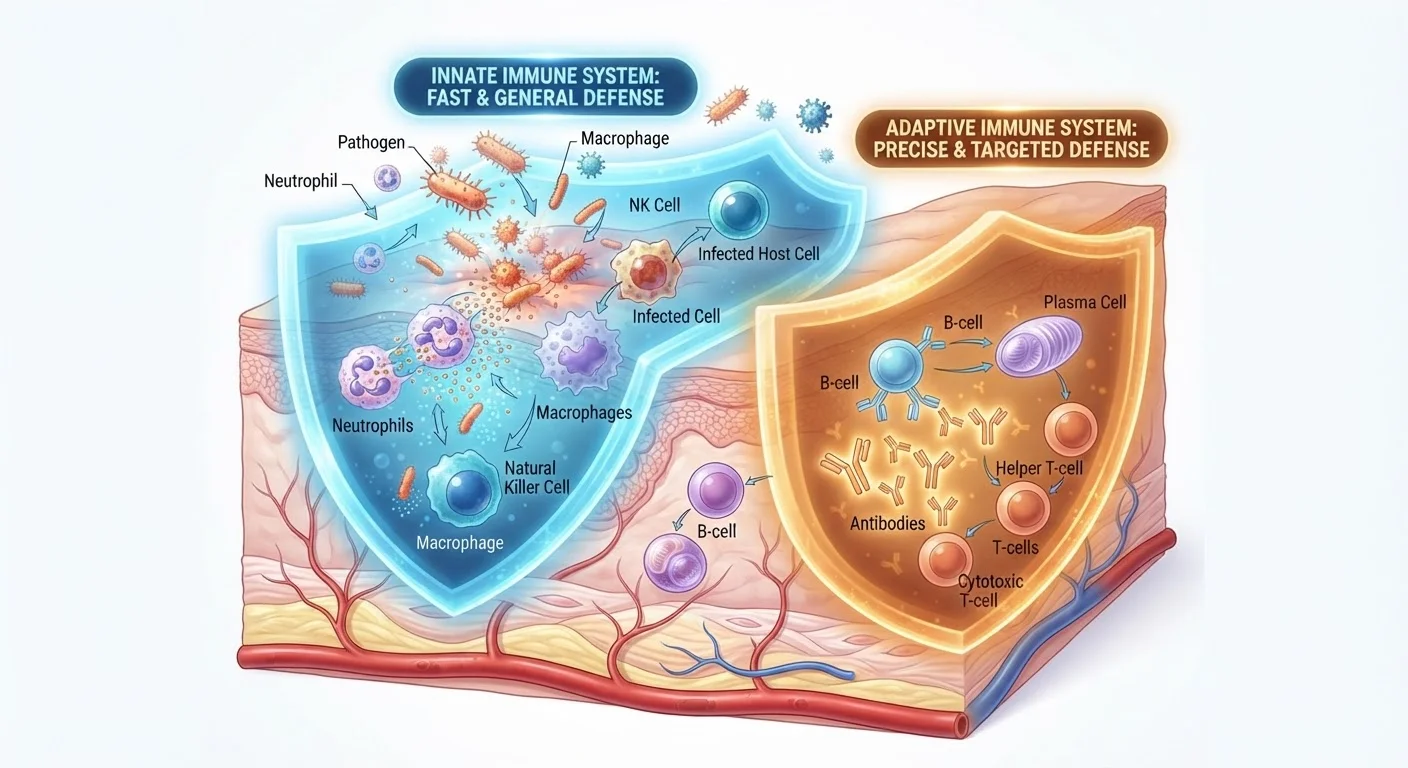
The body's fast, broad-spectrum first line of defence.
Best for: Immediately containing any unfamiliar threat before the body can mount a targeted response.
Option B
Adaptive Immunity
The precision response system that learns and remembers pathogens.
Best for: Eliminating specific pathogens and building long-term immunological memory for future protection.
If you want to understand why infections cause immediate symptoms like fever and swelling
Innate Immunity
Those early symptoms - heat, redness, swelling - are hallmarks of the innate response activating to contain an invader quickly.
If you want to understand how vaccines protect you long-term
Adaptive Immunity
Vaccines train the adaptive immune system to recognise specific pathogens and produce a faster, stronger response upon future exposure.
If you are exploring autoimmune conditions or immune dysfunction
Adaptive Immunity
Most autoimmune disorders involve the adaptive system's precision mechanisms misfiring and targeting the body's own tissues.
Two Systems, One Goal
Your immune system is not a single mechanism - it is a layered defence network. At its core are two interconnected arms: the innate immune system and the adaptive immune system. Both work toward the same goal of protecting you from pathogens (disease-causing organisms like bacteria and viruses), but they operate on different timelines and with very different strategies.
For a thorough foundation, see Your Immune System, Explained, which covers key players like white blood cells and antibodies. This article focuses specifically on how these two arms contrast - and why both are essential.
| Criterion | Innate Immunity | Adaptive Immunity |
|---|---|---|
| Speed of response | Minutes to hours | Days to weeks |
| Specificity | Broad, non-specific | Highly targeted to one pathogen |
| Key cells | Neutrophils, macrophages, NK cells | B cells, T cells (lymphocytes) |
| Immunological memory | No memory formed | Yes - core to long-term protection |
| Role in vaccination | Minimal direct role | Primary mechanism; memory is key |
| Typical signs of activation | Fever, swelling, redness, pain | Antibody production, targeted cell death |
Innate Immunity: Your Body's Rapid First Responder
The innate immune system is the older of the two in evolutionary terms and activates within minutes to hours of detecting a threat. It does not need to identify a pathogen precisely - it simply recognises broad patterns common to many harmful microbes.
Key components include physical barriers like skin and mucous membranes, as well as immune cells such as neutrophils, macrophages, and natural killer (NK) cells. When a pathogen breaches these defences, the innate system triggers inflammation - redness, swelling, heat, and pain - as it works to contain the threat. To understand how this unfolds during a real infection, see what happens inside your body during an infection.
The innate response also alerts the adaptive system that backup is needed, acting as a critical communication bridge between both arms.
~4 days
Time for adaptive response to mobilise
According to immunology research, the adaptive immune response typically begins generating a significant antibody response around 4-7 days after initial exposure to a new pathogen.
Millions
Unique antigens B cells can recognise
The NIH notes that the adaptive immune system can generate millions of distinct antibodies, each recognising a different molecular target on a pathogen's surface.
Adaptive Immunity: Precision, Memory, and Long-Term Protection
Where the innate system is fast and general, the adaptive immune system is slow and highly specific. It typically takes several days to two weeks to mount a full response, because it must first identify the exact pathogen, then activate and multiply the right immune cells to fight it.
The key players here are B cells and T cells (types of lymphocytes). B cells produce antibodies - proteins that bind to specific targets called antigens on the surface of pathogens. T cells either kill infected cells directly or coordinate the broader immune response. For clear definitions of these terms, visit Key Immune System Terms Every Adult Should Know.
Crucially, the adaptive system retains immunological memory: after defeating a pathogen, it keeps specialised memory cells in reserve. If the same pathogen appears again, the response is dramatically faster and more powerful - often neutralising the threat before you even feel sick. This is the biological principle that underlies vaccination.
When adaptive immunity malfunctions and targets the body's own tissues, autoimmune conditions can result. Learn more in When Your Immune System Turns on Itself.
How the Two Systems Work Together
It would be a mistake to think of innate and adaptive immunity as separate or competing systems. They are deeply interdependent. The innate system buys time and sends chemical signals (called cytokines) that activate and guide adaptive immune cells. Without this handoff, the adaptive system might not respond at all.
Inflammation - a cornerstone of innate immunity - is one of the key signals that alerts the adaptive system and recruits immune cells to the site of infection. This double-edged process is explored further in Inflammation: Protector or Problem?.
When Either System Becomes Overactive
Both immune arms can cause harm when dysregulated. An overactive innate response can lead to damaging systemic inflammation (as seen in severe infections). An overactive adaptive response can result in autoimmune disease, where the body attacks its own tissue. Neither system is inherently 'better' - balance between them is what supports good immune health.
This article is for informational purposes only and does not constitute medical advice. Always consult a qualified healthcare professional for personal health concerns, symptoms, or treatment decisions.