
Sport-Specific Training vs. General Fitness: What the Distinction Means in Practice

Key Takeaways
Option A
Sport-Specific Training
Precision training built around the demands of a single sport.
Best for: Athletes, recreational competitors, or anyone preparing for a specific sporting event or activity.
Option B
General Fitness Training
Balanced, broad conditioning for everyday health and longevity.
Best for: Anyone seeking improved health, energy, and physical function without a competitive goal in mind.
If you want to improve your overall health and daily energy
General Fitness Training
General fitness builds cardiovascular health, strength, flexibility, and balance without requiring sport-specific expertise or high training volume - ideal for sustainable, long-term wellbeing.
If you compete or plan to compete in a specific sport
Sport-Specific Training
Competing at your best requires training the exact physical qualities and movement patterns your sport demands, making sport-specific programming the logical choice.
If you're a complete beginner with no competitive goals
General Fitness Training
Lower barriers to entry, reduced injury risk, and a broader skill base make general fitness the safer, more motivating starting point for newcomers.
If you play a recreational sport but also want overall health benefits
General Fitness Training
A well-rounded general program improves the foundational fitness that supports recreational sport participation without the intensity of a competitive training plan.
How Each Approach Defines Its Goal
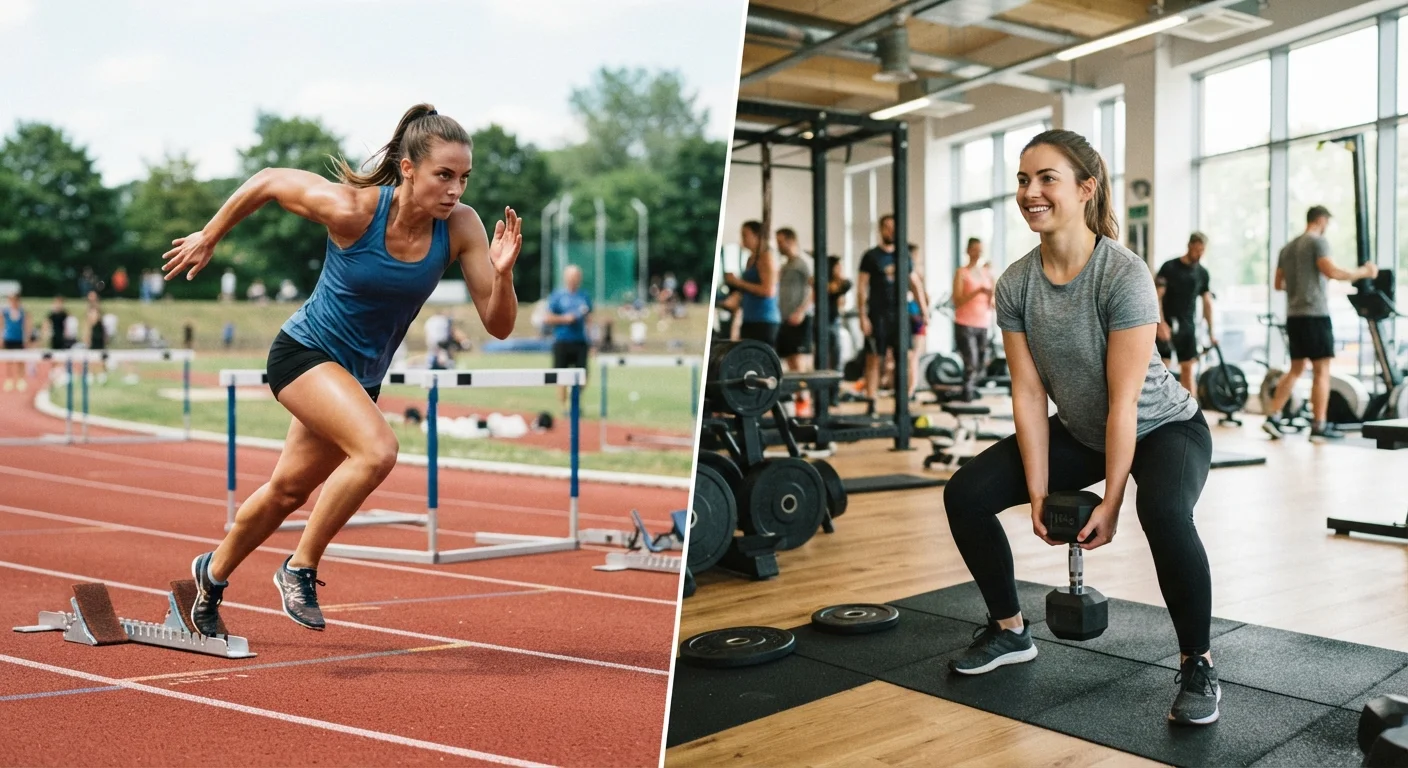
The clearest way to understand this distinction is to look at what each approach is optimizing for. Sport-specific training is designed to improve performance in one activity - say, soccer, swimming, or tennis. Every exercise choice, intensity level, and weekly schedule is selected because it directly transfers to that sport's demands.
General fitness training, by contrast, aims for broad physical competence and health. The American College of Sports Medicine (ACSM) recommends that adults pursue a mix of aerobic activity, muscle-strengthening work, and flexibility training - not to win races, but to reduce chronic disease risk, maintain function, and support mental wellbeing. To understand how these exercise types work at a physiological level, see the major exercise categories and what each one actually does.
In practical terms: a general fitness routine might include three days of moderate cardio, two days of full-body strength work, and regular stretching. A sport-specific plan for a competitive cyclist might include power intervals calibrated to race intensity, leg-dominant strength work, and almost no upper-body training - because the sport doesn't require it.
| Criterion | Sport-Specific Training | General Fitness Training |
|---|---|---|
| Primary goal | Maximize sport performance | Improve overall health and function |
| Exercise selection | Sport-relevant movements only | Balanced, multi-modal variety |
| Intensity level | High; periodized around competition | Moderate; consistent and manageable |
| Injury risk profile | Higher; overuse patterns common | Lower with appropriate progression |
| Suitable for beginners | Generally not recommended | Yes; most beginner-friendly |
| Recovery demands | Significant; structured rest required | Moderate; rest days still essential |
| Flexibility of schedule | Low; dictated by training cycles | High; adaptable to lifestyle |
Structure, Intensity, and Weekly Demand
General fitness programs typically follow balanced, manageable structures. Most beginners can start with 150 minutes of moderate aerobic activity per week alongside two strength sessions - a threshold supported by the ACSM and the U.S. Department of Health and Human Services. This volume supports health without overwhelming the body or demanding significant recovery resources.
Sport-specific training often involves periodization - a planned, phased approach where training intensity and volume vary across weeks and months to peak performance around a competition. This model can be complex and demands more attention to recovery. For a deeper look at why rest is a non-negotiable part of any plan, explore the Recovery & Rest hub.
For beginners, higher training loads carry a meaningful injury risk if progression isn't carefully managed. Sport-specific programs also tend to create physical imbalances over time - a swimmer's shoulder dominance or a runner's tight hip flexors - which general fitness programming actively works to prevent through balanced, multi-directional movement.
150 min
Recommended weekly moderate aerobic activity
Per ACSM and U.S. Department of Health and Human Services guidelines for general adult health.
2x/week
Minimum strength training frequency for health
Public health guidelines recommend at least two muscle-strengthening sessions per week for adults.
~70%
Of sports injuries linked to overuse
Research published in sports medicine literature consistently identifies overuse as the leading injury mechanism in trained athletes.
Method Overlap and Where the Lines Blur
Both approaches use many of the same tools: resistance training, cardiovascular conditioning, and flexibility work appear in both. The difference lies in emphasis, selection, and specificity. A general fitness participant doing squats is building functional lower-body strength; a basketball player doing squats is also building the explosive hip extension needed for jumping.
Functional fitness sits interestingly between the two approaches. It trains movements your body uses in daily life - carrying, bending, pushing - making it relevant to both general health seekers and athletes looking to build a resilient physical base.
Similarly, understanding how cardio and strength training differ is valuable whether you're training for a 5K or simply trying to stay active. Both approaches require you to make informed choices about which modalities to include - and why. For those incorporating resistance work into either goal, the distinctions between free weights, machines, and bodyweight work are worth understanding early.
This article is for general informational purposes only and does not constitute medical or professional fitness advice. Consult a qualified healthcare provider or certified fitness professional before beginning any new exercise program, especially if you have existing health conditions.
Neither Approach Is Superior for Everyone
Sport-specific training isn't inherently better than general fitness - it's simply more narrowly focused. Many recreational athletes thrive on general fitness programs that include their sport as one component, rather than centering an entire plan around it. Your goals, schedule, and enjoyment should guide which path makes sense for you at this stage of your fitness journey.