

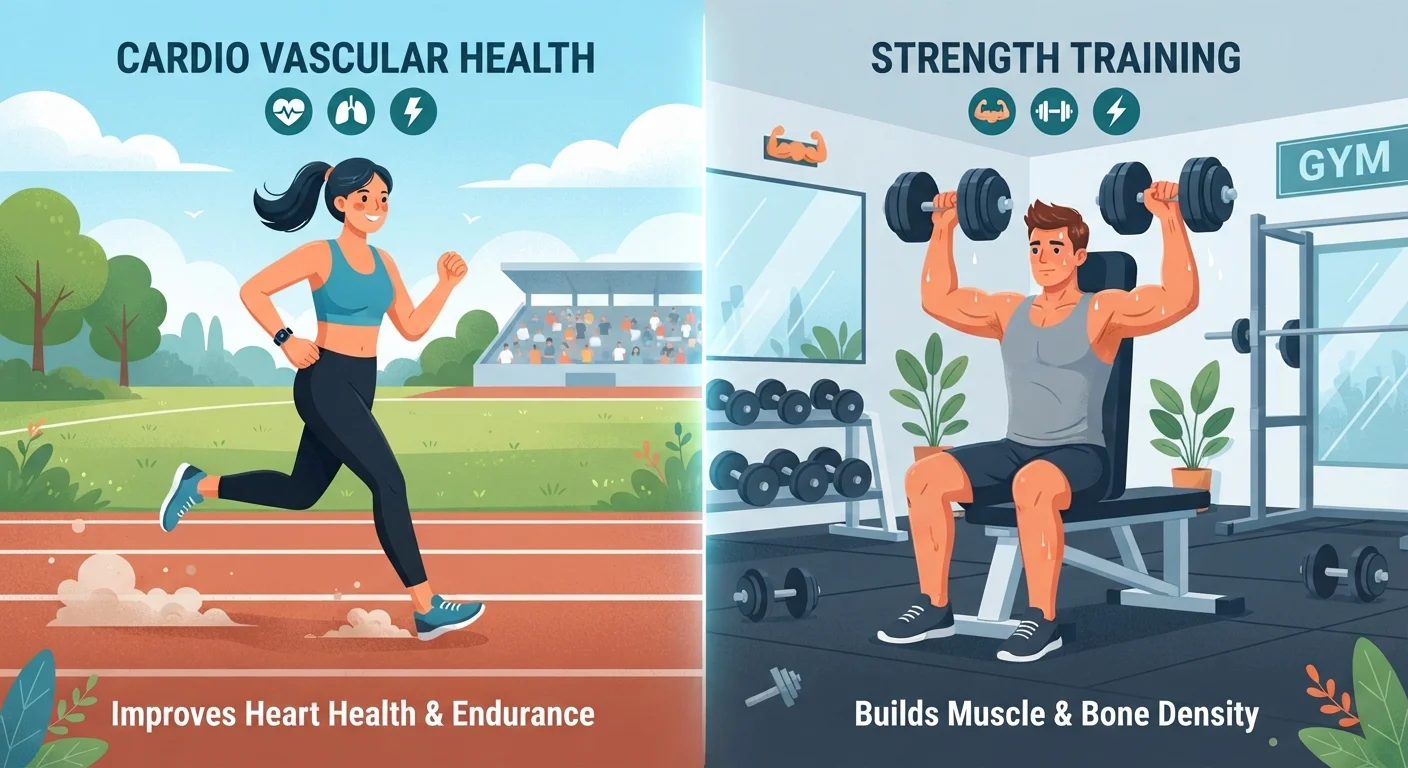
Key Takeaways
Option A
Cardiovascular Training
The endurance-focused, heart-driven training style.
Best for: People who want to improve heart health, stamina, and overall aerobic capacity through sustained, rhythmic movement.
Option B
Strength Training
The resistance-based, muscle-building approach.
Best for: People who want to build muscle, increase functional strength, and support long-term metabolic and bone health.
If your primary goal is improving heart and lung endurance
Cardiovascular Training
Cardio consistently elevates heart rate over time, strengthening the cardiovascular system and boosting aerobic capacity more directly than resistance work.
If you want to build muscle mass and functional strength
Strength Training
Resistance training creates the mechanical tension and muscle damage signals that drive muscle growth and strength adaptation over time.
If you want broad, well-rounded fitness as a beginner
Cardiovascular Training
Starting with cardio builds a foundation of aerobic fitness and movement confidence before adding the technique demands of resistance work.
If long-term bone density and metabolic health are priorities
Strength Training
Progressive resistance training is one of the most effective tools for preserving bone mineral density and sustaining resting metabolic rate as you age.
What Each Type of Training Actually Asks of Your Body
At the most fundamental level, cardiovascular training and strength training make entirely different demands on your physiology. Understanding those demands is the fastest way to figure out how each type fits into your life.
Cardiovascular training - often called cardio - involves continuous, rhythmic movement that keeps your heart rate elevated for an extended period. Think running, cycling, swimming, or brisk walking. The primary challenge here is aerobic: your body must deliver oxygen to working muscles efficiently and sustain that effort over time. Your heart, lungs, and circulatory system are the main systems being trained.
Strength training (also called resistance training) works on a completely different principle. It requires your muscles to exert force against some form of resistance - whether that's a barbell, resistance band, or your own bodyweight. The effort is typically shorter and more intense per set, and the goal is to challenge muscles beyond what they're used to so they adapt and grow stronger. For a broader look at how these and other modalities fit together, see the major exercise categories explained.
| Criterion | Cardiovascular Training | Strength Training |
|---|---|---|
| Primary system trained | Heart, lungs, circulatory system | Muscles, tendons, bones |
| Energy system used | Aerobic (oxygen-dependent) | Anaerobic (short, intense bursts) |
| Typical session structure | Sustained effort, 20-60 minutes | Sets and reps with rest intervals |
| Key long-term adaptation | Improved cardiovascular efficiency | Increased muscle mass and strength |
| Bone density benefit | Moderate (weight-bearing types) | Strong, well-documented benefit |
| Equipment needed | Often minimal (walking, running) | Varies (bodyweight to barbell) |
| Beginner learning curve | Low - most forms are intuitive | Moderate - technique matters |
How Each One Changes Your Body Over Time
The adaptations produced by cardio and strength training differ significantly - and both matter for long-term health.
Regular cardiovascular exercise strengthens the heart muscle itself, improves the efficiency of oxygen delivery, lowers resting heart rate, and can reduce blood pressure over time. The American College of Sports Medicine (ACSM) identifies aerobic exercise as a cornerstone of cardiovascular disease risk reduction. If you want to explore the range of cardio formats available, HIIT, LISS, and steady-state cardio each work differently.
Strength training, by contrast, builds lean muscle mass, supports bone mineral density, and improves joint stability. As muscle mass increases, your resting metabolic rate tends to rise - meaning your body burns more calories even at rest. Research consistently links resistance training to better blood sugar regulation and reduced risk of metabolic syndrome. Men in particular may benefit from understanding what cardio and strength training each do for long-term male health.
150 min
Weekly moderate cardio recommended for adults
The ACSM and the U.S. Department of Health and Human Services recommend at least 150 minutes of moderate-intensity aerobic activity per week for healthy adults.
2x/week
Minimum strength sessions recommended
Major health guidelines, including those from the ACSM, recommend muscle-strengthening activities for all major muscle groups at least twice per week.
~3-8%
Muscle mass lost per decade after age 30 without training
Research on sarcopenia (age-related muscle loss) estimates adults can lose roughly 3-8% of muscle mass per decade from around age 30 without resistance training.
It's worth noting that the two are not mutually exclusive. Most exercise physiology guidelines - including those from the ACSM and the National Strength and Conditioning Association (NSCA) - recommend combining both for comprehensive health benefits.
Choosing the Right Balance for Where You Are Now
There's no universal prescription for how much cardio versus strength training you need - it depends on your current fitness level, health goals, and available time. That said, a few principles apply broadly to beginners.
If you're new to structured exercise, starting with lower-intensity cardio (like walking or light cycling) is a low-risk way to build cardiovascular fitness and movement confidence simultaneously. Once you feel comfortable with consistent movement, layering in basic resistance exercises - such as bodyweight squats, push-ups, or resistance band work - adds meaningful complementary benefits. Bodyweight, free weights, and machines each have distinct trade-offs worth understanding before you begin.
A Note on Special Populations
Older adults, people managing chronic conditions, and those returning from injury should seek personalized guidance before beginning either cardio or strength training. General recommendations may not account for individual health factors. A physician or certified exercise professional can help design a program that is both safe and effective for your specific situation.
If your goals are sport-related rather than general fitness, the balance shifts further. Sport-specific training and general fitness programming diverge considerably in structure and emphasis.
This article is for general informational purposes only and does not constitute medical or personal fitness advice. Consult a qualified healthcare provider or certified fitness professional before starting any new exercise program, especially if you have an existing health condition.