
Resistance Training, Weight Machines, and Bodyweight Work: What Sets Them Apart

Key Takeaways
Our Verdict
Free weights, machines, and bodyweight training each occupy a legitimate place in a well-rounded fitness plan. No single method is universally superior - they differ most meaningfully in how much skill they require to perform safely, how much access they need, and which muscle groups and movement qualities they develop most effectively. Beginners benefit from starting conservatively with machines or bodyweight before progressing to free weights as coordination improves.
| Best for | Recommended |
|---|---|
| Beginners learning movement patterns safely | Weight Machines |
| Those training at home without equipment | Bodyweight Training |
| Building overall strength and muscle balance | Free Weights |
| Developing functional, real-world movement ability | Bodyweight Training |
What Resistance Training Actually Means
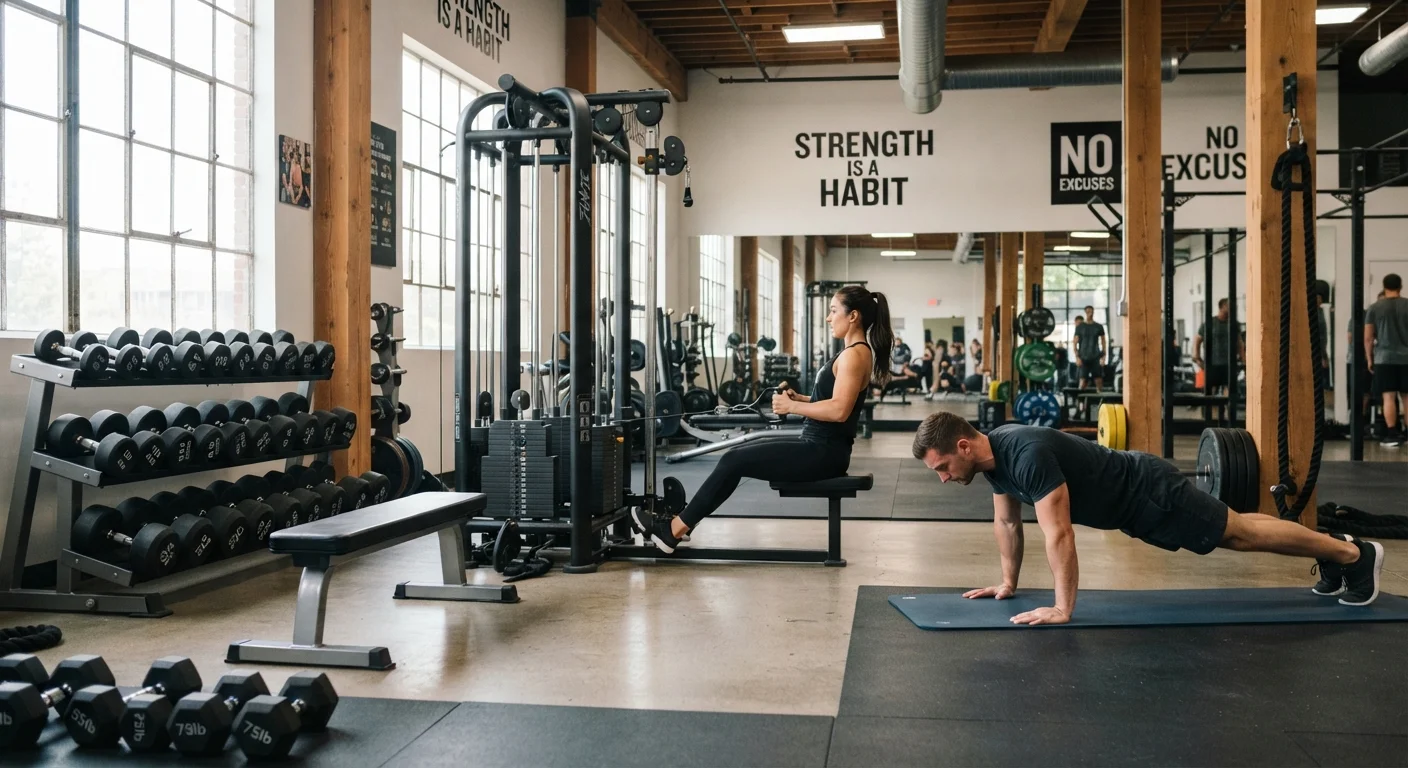
Resistance training is any form of exercise that makes your muscles work against an opposing force. That force can come from gravity acting on a dumbbell, a cable pulley system, or simply your own body weight. The underlying principle - progressive overload, meaning gradually increasing the challenge over time - applies equally to all three formats.
Understanding how these approaches differ matters because it helps you match a training method to your goals, schedule, and starting point. See our overview of major exercise categories to understand where resistance training fits within a complete fitness routine.
| Free Weights | Weight Machines | Bodyweight | |
|---|---|---|---|
| Equipment needed | Dumbbells, barbells, or kettlebells | Gym or home machine setup | None |
| Beginner-friendliness | Moderate - technique matters | High - guided movement path | High - easy to start safely |
| Stabilizer muscle demand | High | Low | Moderate to high |
| Progression method | Add weight incrementally | Adjust weight stack | Harder variations or volume |
| Functional carryover | High | Moderate | High |
| Portability | Limited | Very limited | Complete - train anywhere |
| Injury risk (poor form) | Higher | Lower | Low to moderate |
Free Weights: Versatile but Technique-Dependent
Free weights - including dumbbells, barbells, and kettlebells - move freely through space. Because no machine guides their path, your body must recruit stabilizer muscles to control the movement. This makes free weight exercises more demanding on coordination and proprioception (your body's sense of its own position in space), but also more transferable to real-world activities.
The main practical limitation for beginners is that poor form carries a higher injury risk than with guided equipment. Investing time in learning technique - ideally with qualified coaching - is especially important before adding heavy loads. That said, free weights are highly adaptable: a single pair of adjustable dumbbells can support a wide range of exercises at home or in the gym.
Start Light, Focus on Form First
When beginning with free weights, choose a load that allows you to complete all repetitions with controlled, deliberate movement - never sacrificing form to lift heavier. Many trainers recommend spending the first two to four weeks simply practicing movement patterns with minimal load. Recording yourself or working with a certified trainer can accelerate this learning curve safely.
Weight Machines: Structured and Beginner-Friendly
Weight machines constrain your movement to a fixed path, which means less demand on stabilizer muscles but also a lower skill threshold to begin safely. For someone new to the gym, a leg press or seated row machine provides a controlled environment to learn how a movement feels and to build initial strength without requiring much technical coaching.
Machines are also useful for isolating specific muscles - the leg extension machine targets the quadriceps with minimal involvement from other muscle groups, for example. This can be valuable during rehabilitation or when targeting a muscle group that is underdeveloped relative to others. The trade-off is that the fixed path may not suit everyone's body proportions perfectly, and they offer limited carryover to movements requiring full-body coordination.
If you're deciding between a home or gym setup, our comparison of home and gym training environments covers the practical considerations in detail.
Bodyweight Training: Accessible and Functional
Bodyweight exercises - push-ups, squats, lunges, planks, and pull-ups - use your own mass as resistance. The primary advantage is accessibility: no equipment, no gym membership, and the ability to train almost anywhere. For many beginners, bodyweight work is the most practical entry point into resistance training.
Bodyweight movements also tend to develop functional strength - the kind that supports posture, balance, and everyday tasks like lifting, carrying, and climbing stairs. This overlaps meaningfully with what's often called functional fitness; see our guide to functional fitness training for a closer look at that concept.
One limitation: progression is less straightforward than adding weight to a barbell. As you grow stronger, advancing bodyweight exercises requires either increasing the volume (more repetitions or sets), changing leverage (elevating feet for push-ups), or choosing harder variations (single-leg squats). This learning curve is manageable but requires some planning.
2-3×
Recommended resistance sessions per week
The ACSM recommends adults perform resistance training targeting all major muscle groups at least two to three days per week for general health benefits.
~20%
Strength gain in 8-12 weeks (beginners)
Exercise physiology research consistently shows beginners can experience meaningful strength improvements within the first two to three months of consistent resistance training, largely driven by neuromuscular adaptations.
Mixing Methods: The Case for Using All Three
In practice, most effective training programs draw from more than one approach. Machines may anchor early sessions while a beginner learns to move safely. Bodyweight exercises fill in on rest days or travel. Free weights become more prominent as technique and confidence develop.
Research from organizations like the American College of Sports Medicine (ACSM) consistently supports multi-modal resistance training - combining different equipment types and movement patterns - as an effective approach for building overall fitness and reducing the monotony that leads to dropout. Your beginner workout plan is a sound place to start structuring these elements together.
Whatever combination you choose, recovery is just as important as training itself. Rest and recovery practices allow muscles to adapt and grow stronger between sessions.
This article is for general informational and educational purposes only and does not constitute medical or fitness advice. Always consult a qualified healthcare professional or certified trainer before beginning a new exercise program, particularly if you have an existing health condition or injury.