
Home Workouts vs. Gym Workouts for Beginners: Weighing Up Both Environments

Key Takeaways
Our Verdict
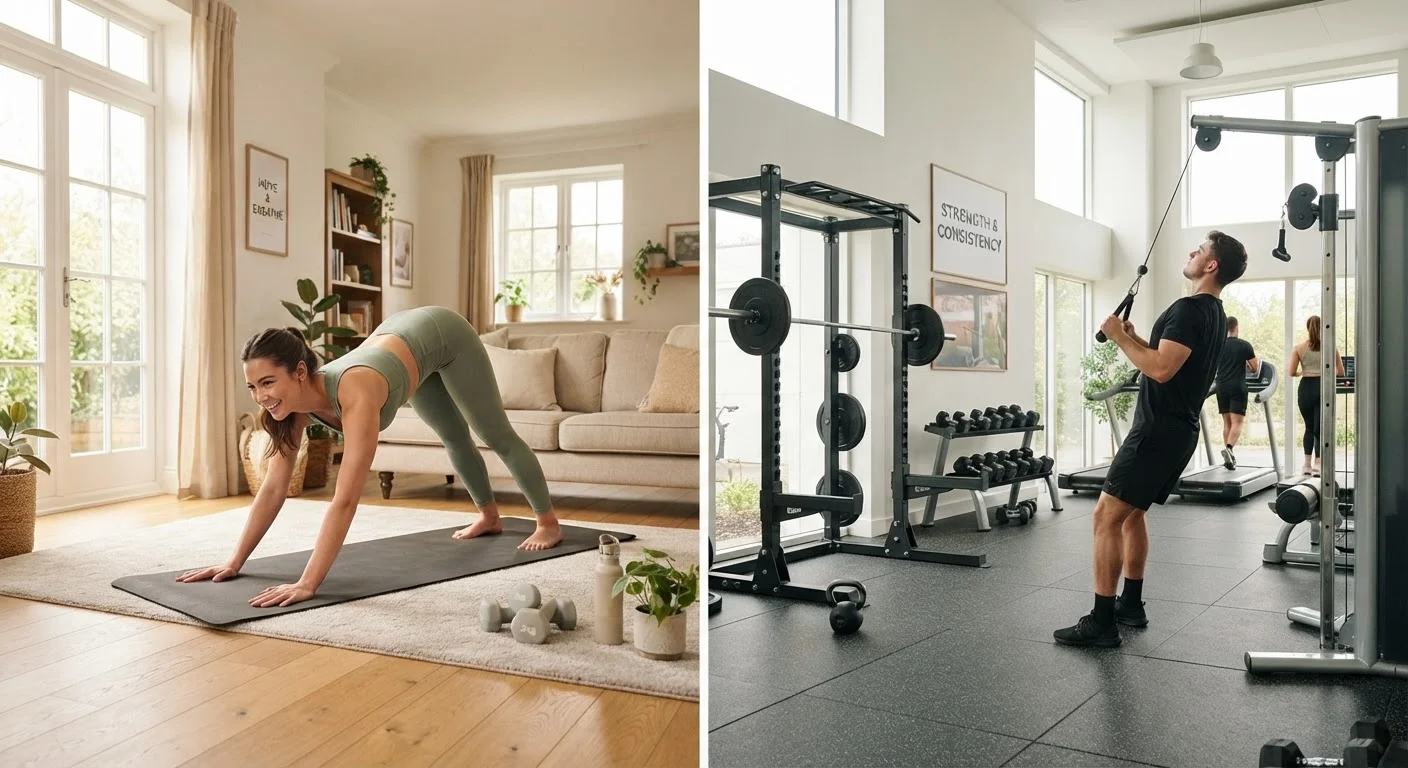
Home workouts and gym workouts each offer genuine advantages for beginners. Home training wins on convenience, privacy, and low upfront cost, while gyms deliver equipment variety, expert access, and a dedicated training environment. The right choice depends on how you best stay consistent - and consistency is the single most important variable for any newcomer.
| Best for | Recommended |
|---|---|
| Those with tight budgets or unpredictable schedules | Home Workouts |
| Beginners who want guided progression and equipment variety | Gym Workouts |
| Anyone who values privacy and low intimidation when starting out | Home Workouts |
| Those motivated by community and structured environments | Gym Workouts |
Why Your Training Environment Matters From Day One
When you're new to exercise, the biggest predictor of long-term success isn't which program you follow - it's whether you actually show up. Your environment plays a direct role in that. A setting that fits your schedule, comfort level, and personality makes it far easier to build the habit of moving regularly.
Home and gym training are not simply the same workout done in different locations. They differ in equipment access, social dynamics, cost, safety considerations, and the psychological cues that either pull you toward exercise or make it easy to skip. Understanding those differences up front helps you choose a starting point that works for you - not just in theory, but in practice. If you're still exploring what kind of movement resonates with you, the Workout Style Starter Map is a useful place to begin.
| Home Workouts | Gym Workouts | |
|---|---|---|
| Upfront Cost | Low - mat and basic equipment optional | Moderate - membership fees required |
| Convenience | Very high - no travel needed | Moderate - depends on proximity |
| Equipment Variety | Limited without investment | Extensive - cardio, weights, machines |
| Expert Guidance | Self-directed or online resources | In-person trainers often available |
| Privacy Level | Complete privacy at all times | Shared public space |
| Progression Options | Can plateau without added equipment | Easy to increase load gradually |
| Social Motivation | Low unless using virtual classes | High - community and accountability |
| Beginner-Friendliness | High - low pressure environment | Varies - can feel intimidating initially |
The Real Advantages of Working Out at Home
The most significant benefit of home training is the removal of friction. There is no commute, no locker room, no waiting for equipment. For beginners, this matters enormously - research on habit formation consistently shows that reducing the number of steps between intention and action increases follow-through.
Cost is another meaningful factor. Beyond a basic mat and perhaps a set of resistance bands or light dumbbells, home workouts require minimal investment. Bodyweight exercises - such as squats, push-ups, lunges, and planks - are physiologically effective for building foundational strength and improving cardiovascular fitness. The comparison of bodyweight training and gym machines covers this in greater detail.
Privacy is also a genuine advantage for many newcomers who feel self-conscious about their fitness level. Exercising at home removes that social pressure entirely, allowing you to focus on learning movement patterns without distraction.
Start With What You'll Actually Do
If the idea of going to a gym feels like a barrier right now, a solid home routine with bodyweight movements is a perfectly legitimate place to start. Consistency built at home transfers directly to the gym later if you choose to go. The American College of Sports Medicine (ACSM) supports the principle that any moderate physical activity performed consistently produces meaningful health benefits - location is secondary to regularity.
Where the Gym Has a Clear Edge
Gyms provide access to a range of equipment that most people cannot replicate at home - barbells, cable machines, benches, cardio equipment, and more. For beginners who want to progress beyond bodyweight movements relatively quickly, this variety matters. It allows for graduated load increases, which is a core principle of strength development known as progressive overload.
Many gyms also employ certified fitness professionals who can assess your form, recommend appropriate starting weights, and design a structured program. This guidance significantly reduces injury risk - an important consideration when you are learning new movement patterns. If you are considering adding group classes to your gym experience, weigh those options carefully with our guide to starting a group fitness class as a beginner.
The social environment of a gym can also be motivating for people who thrive on external accountability. Seeing others train - even strangers - often provides a subtle but real psychological boost that is hard to replicate at home.
~80%
Adults not meeting activity guidelines
The CDC estimates that approximately 80% of U.S. adults do not meet both aerobic and muscle-strengthening physical activity guidelines, highlighting how much room there is to start - in any environment.
2-3x/week
Recommended strength sessions for beginners
The ACSM recommends that beginners perform muscle-strengthening activities at least two to three days per week, a frequency achievable in both home and gym settings.
Common Pitfalls in Each Setting
Home workouts carry a real risk of stagnation. Without structured progression or access to heavier loads, it can be difficult to continue challenging your muscles over time. Distractions - family, household tasks, screens - can also undermine focus. Creating a dedicated space and a consistent schedule helps, but requires intentional effort.
Gyms present their own challenges. For beginners, the environment can feel intimidating. Equipment may be unfamiliar, and without guidance there is a risk of improper technique leading to strain or injury. Membership costs and travel time are practical barriers that genuinely prevent some people from attending regularly.
Avoid Training Without Learning Form First
In both settings, beginners are most at risk of injury when they attempt exercises without understanding the correct technique. At home, poor form often goes unchecked without a mirror or feedback. At the gym, the temptation to lift heavy too soon is a common mistake. Start with lighter loads and simpler movements, and consider seeking at least one or two sessions with a certified trainer - in person or via a reputable online platform - to establish safe movement patterns before progressing.
Before committing to either path, it is worth reviewing the readiness checklist for starting a new workout type to assess your baseline and health considerations. And remember: for individuals with existing health conditions, injuries, or special circumstances such as pregnancy, consulting a qualified healthcare professional before beginning any exercise program is essential.
This article is for general informational and educational purposes only. It does not constitute medical advice. Always consult a qualified healthcare professional before starting a new exercise routine, particularly if you have any underlying health conditions.