

Key Takeaways
Built-in structure removes decision fatigue for beginners
A pre-designed class means you show up and follow along - no programming knowledge required. This lowers the barrier to starting enormously for people with no training background.
Scheduled classes support consistent habit formation
Fixed class times create external commitment points that make it easier to exercise regularly. Consistency in the early weeks is one of the strongest predictors of long-term adherence.
Instructor cueing teaches movement patterns in real time
A qualified group fitness instructor provides live verbal and visual cues that help beginners learn how exercises should feel and look - something a written routine or app cannot replicate as immediately.
Social environment boosts motivation during hard moments
Exercising alongside others can make effort feel more manageable. Studies in social facilitation suggest that the presence of others engaged in the same activity can increase output and enjoyment.
Wide variety of formats helps beginners explore preferences
From dance cardio to yoga to cycling, group classes let beginners sample different movement styles before committing to a specific training approach - accelerating the process of finding what they actually enjoy.
Pace may outrun a true beginner's movement ability
Group classes are paced for a general participant, not an individual. Beginners still developing foundational movement patterns can struggle to keep up, increasing the temptation to sacrifice form for speed.
Limited individual feedback from a single instructor
In a class of 15-30 people, an instructor cannot provide detailed form correction to each participant. Beginners may ingrain movement errors without realizing it, which can become harder to correct over time.
Social comparison can drive unsafe effort levels
Beginners surrounded by experienced exercisers often push past appropriate intensity limits out of self-consciousness. This undermines the ACSM's principle of gradual, individualized progression.
Fixed scheduling lacks flexibility for irregular lives
Class times are set in advance and may not align with variable work schedules, childcare demands, or fatigue levels on a given day - a real barrier for beginners still establishing routine.
Cost can be a significant barrier over time
Boutique group fitness studios in particular carry premium pricing that can make regular attendance financially unsustainable, especially for beginners who are still testing whether the format suits them.
Our Verdict
Group fitness classes offer real advantages for beginners - structure, motivation, and a sense of community can all accelerate habit formation. However, pacing, cost, and the potential for intimidation are legitimate concerns worth weighing honestly. Neither universally ideal nor universally problematic, group classes work best when matched to your current fitness level and personal preferences.
Best for beginners who thrive with social accountability, enjoy trying new movement styles, and feel comfortable asking instructors for modifications when needed.
Why Group Classes Feel Like a Natural Entry Point
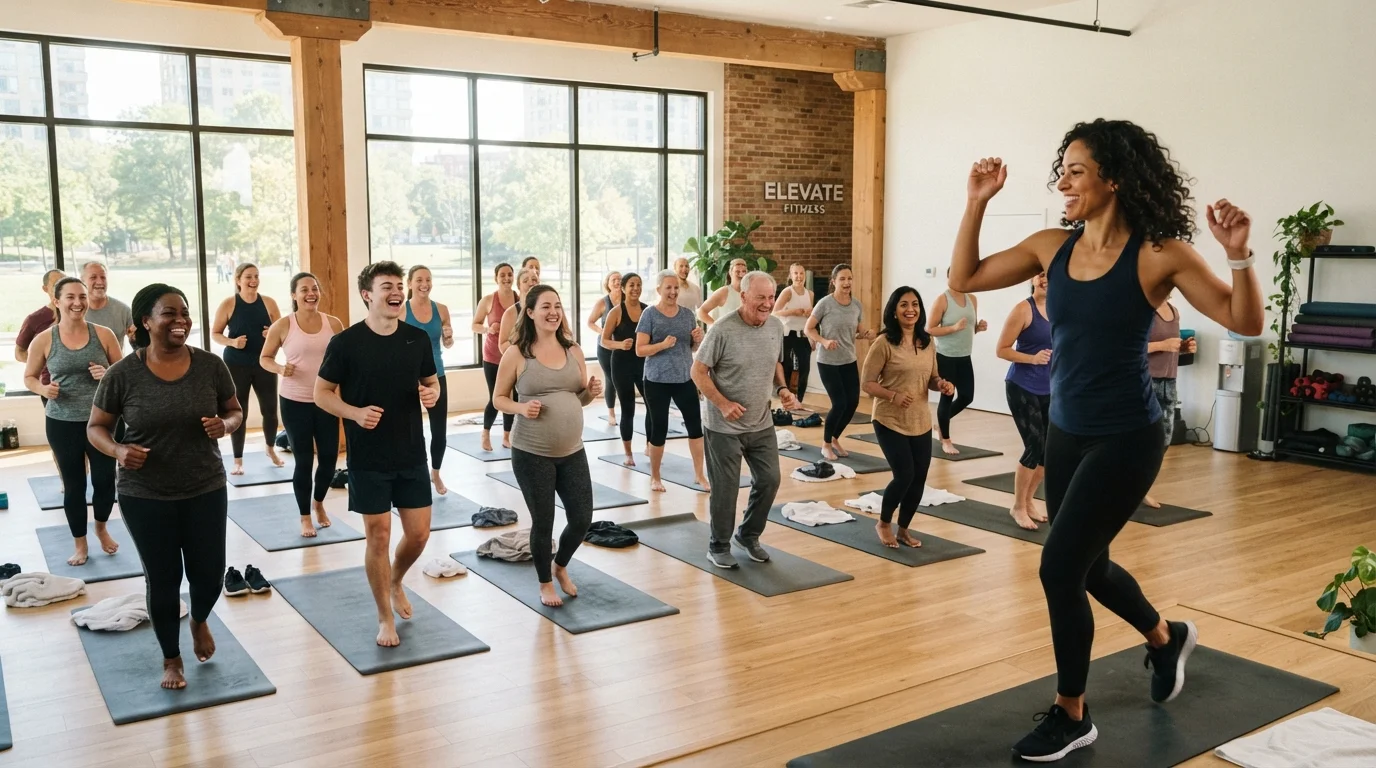
When you're new to exercise, decisions pile up fast: what to do, how long, how hard, in what order. A group fitness class removes most of that guesswork. Someone else designs the session, sets the tempo, and cues every movement - making it one of the most structured environments a beginner can walk into.
That structure matters. Research in exercise psychology consistently links external accountability (an instructor, a scheduled class time, other participants) with improved exercise adherence, especially in the early weeks. If you're still building the habit, a class that starts at 9 a.m. Tuesday and Thursday gives your routine a framework to grow around.
Before deciding whether a class is right for you, it helps to understand what being a fitness beginner really means - because that shapes which class formats will actually serve you well.
Built-in structure removes decision fatigue for beginners
A pre-designed class means you show up and follow along - no programming knowledge required. This lowers the barrier to starting enormously for people with no training background.
Scheduled classes support consistent habit formation
Fixed class times create external commitment points that make it easier to exercise regularly. Consistency in the early weeks is one of the strongest predictors of long-term adherence.
Instructor cueing teaches movement patterns in real time
A qualified group fitness instructor provides live verbal and visual cues that help beginners learn how exercises should feel and look - something a written routine or app cannot replicate as immediately.
Social environment boosts motivation during hard moments
Exercising alongside others can make effort feel more manageable. Studies in social facilitation suggest that the presence of others engaged in the same activity can increase output and enjoyment.
Wide variety of formats helps beginners explore preferences
From dance cardio to yoga to cycling, group classes let beginners sample different movement styles before committing to a specific training approach - accelerating the process of finding what they actually enjoy.
The Real Drawbacks Beginners Should Know About
Group classes are not designed around any one individual - they're built for a general participant. That's efficient for instructors but can create friction for true beginners whose movement foundations are still forming.
Pace is the most common friction point. Many classes move quickly from one exercise to the next, leaving little time to master a movement before progressing. For someone still learning a bodyweight squat or a basic plank hold, keeping up can mean sacrificing form - and poor form over repeated sessions raises injury risk.
There's also the comparison trap. Surrounded by experienced participants, beginners often push harder than their body is ready for, either out of self-consciousness or a desire to keep pace. The American College of Sports Medicine (ACSM) emphasizes gradual progression as a core principle of safe training - a principle that group dynamics can unintentionally undermine.
For a fuller picture of how group settings stack up against training alone or outdoors, see our comparison of group, solo, and outdoor exercise formats.
Pace may outrun a true beginner's movement ability
Group classes are paced for a general participant, not an individual. Beginners still developing foundational movement patterns can struggle to keep up, increasing the temptation to sacrifice form for speed.
Limited individual feedback from a single instructor
In a class of 15-30 people, an instructor cannot provide detailed form correction to each participant. Beginners may ingrain movement errors without realizing it, which can become harder to correct over time.
Social comparison can drive unsafe effort levels
Beginners surrounded by experienced exercisers often push past appropriate intensity limits out of self-consciousness. This undermines the ACSM's principle of gradual, individualized progression.
Fixed scheduling lacks flexibility for irregular lives
Class times are set in advance and may not align with variable work schedules, childcare demands, or fatigue levels on a given day - a real barrier for beginners still establishing routine.
Cost can be a significant barrier over time
Boutique group fitness studios in particular carry premium pricing that can make regular attendance financially unsustainable, especially for beginners who are still testing whether the format suits them.
How to Make a Group Class Work for You as a Beginner
The good news: most of the drawbacks above are manageable with a little preparation. Here's how to set yourself up for a positive first experience.
- Arrive early and speak to the instructor. Let them know you're new. Good instructors will flag modifications in real time and keep an eye on you during class. This one step changes the experience significantly.
- Choose beginner-labeled or low-intensity formats first. Classes marketed as "beginner," "foundations," or "intro" are paced and cued with newer participants in mind. Yoga, gentle cycling, or low-impact aerobics are generally safer starting points than HIIT or advanced spin.
- Give yourself permission to modify or pause. Taking a rest break, reducing your range of motion, or skipping a complex variation isn't failure - it's smart training. Sustainable progress always beats keeping up for one session.
- Attend the same class two or three times before judging it. The first session often feels overwhelming simply because everything is unfamiliar. Familiarity with the format dramatically reduces cognitive load and lets you focus on movement quality.
A Word on Special Populations
If you are managing a chronic health condition, recovering from injury, are pregnant, or have been sedentary for an extended period, a general group fitness class may not be the safest starting point. In these situations, consult your healthcare provider or a certified personal trainer before joining any class. A supervised one-on-one session may be a more appropriate first step.
If you're weighing a group class against training at home or in a gym independently, our home vs. gym workout comparison for beginners covers the practical trade-offs across cost, environment, and habit-building.
This article is for general informational and educational purposes only and is not a substitute for professional medical or fitness advice. If you have any health conditions, injuries, or concerns, consult a qualified healthcare provider or certified fitness professional before beginning any new exercise program.