
Bodyweight Training vs. Gym Machines: Which Makes More Sense When You're Starting Out?

Key Takeaways
Option A
Bodyweight Training
The accessible, equipment-free way to build strength anywhere.
Best for: Beginners who want to start moving immediately without a gym membership or equipment investment.
Option B
Gym Machines
The guided, structured approach to resistance training in a gym setting.
Best for: Beginners who prefer a controlled environment with clear load progression and staff support.
If you want to start exercising today with zero cost
Bodyweight Training
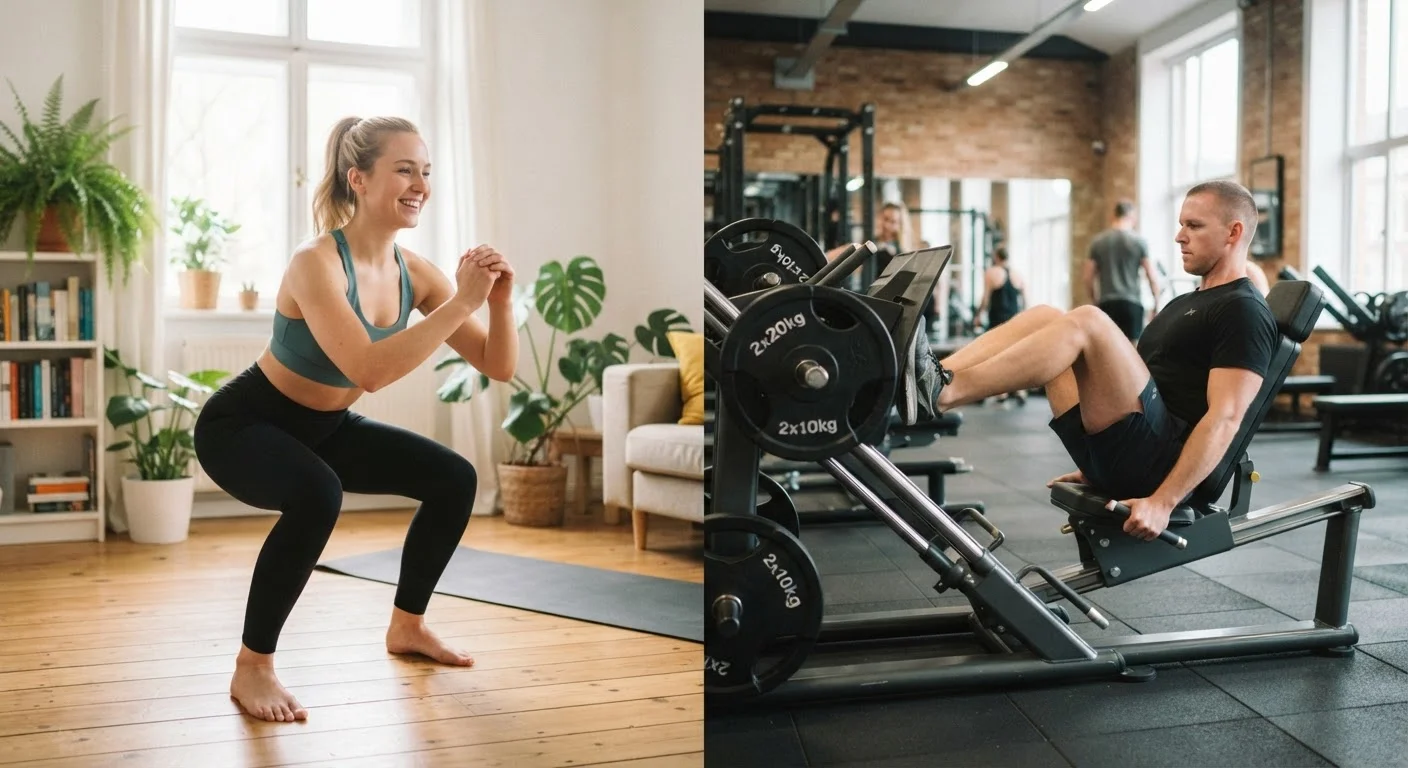
No equipment, no membership, and no commute required. You can begin with movements like squats, push-ups, and planks in any open space.
If you are nervous about doing exercises incorrectly and getting hurt
Gym Machines
Machines constrain your movement to a fixed path, reducing the chance of poor form causing a strain or injury when you're still learning.
If you travel frequently or have an unpredictable schedule
Bodyweight Training
A bodyweight routine travels with you - hotel room, park, or living room, the workout remains consistent regardless of location.
If you want measurable, incremental load increases over time
Gym Machines
Machines allow precise weight stack adjustments in small increments, making progressive overload easier to track as a beginner.
If you want to build a long-term, adaptable fitness foundation
Bodyweight Training
Bodyweight exercises develop balance, coordination, and core stability alongside strength - skills that support nearly every other form of physical activity.
Understanding What Each Approach Actually Is
Before choosing between them, it helps to understand what these two training styles involve at a basic level. For a broader look at how they fit into the overall landscape of exercise, see Resistance Training, Weight Machines, and Bodyweight Work: What Sets Them Apart.
Bodyweight training uses your own body mass as resistance. Common examples include push-ups, squats, lunges, planks, and glute bridges. No gym and no equipment are needed. The difficulty can be adjusted by changing the angle, tempo, or leverage of a movement - for example, elevating your feet on a push-up makes it harder.
Gym machines are fixed-frame resistance devices found in commercial gyms. They guide your limbs along a predetermined movement path and use a weight stack or cable system for resistance. Examples include the leg press, chest press, lat pulldown, and seated row. Resistance is easy to adjust by moving a pin in the weight stack.
Both approaches fall under resistance training - exercise that challenges your muscles against a load to build strength and endurance. The American College of Sports Medicine (ACSM) recommends resistance training for adults of all fitness levels as a core component of a balanced exercise program.
| Criterion | Bodyweight Training | Gym Machines |
|---|---|---|
| Cost | Free - no equipment needed | Gym membership required |
| Location flexibility | Anywhere, anytime | Gym facility only |
| Learning curve | Moderate - form matters | Low - machine guides movement |
| Load progression | Via movement variations | Precise weight increments |
| Balance & coordination benefit | High - trains stabilizers | Low - machine stabilizes you |
| Equipment needed | None | Gym machines |
| Scalability for beginners | Good with progressions | Excellent with weight stack |
Cost, Access, and Convenience
For many beginners, the practical realities of cost and access shape the decision more than any fitness factor. Bodyweight training has essentially no financial barrier - you need only enough floor space to lie down. Gym machines require either a monthly membership fee or access to a facility, along with travel time and operating-hours constraints.
That said, a gym environment offers resources that home training cannot replicate: access to a variety of equipment, the option to work with a personal trainer, and sometimes a motivating social atmosphere. If you're weighing the broader question of where to train, our Home Workouts vs. Gym Workouts for Beginners covers the environmental trade-offs in detail.
Consistency is the single most important variable in any fitness program. Choose the option you will realistically stick to week after week - not the one that looks better on paper.
~80%
Adults who don't meet strength training guidelines
The CDC estimates that roughly 80% of U.S. adults do not meet federal guidelines for both aerobic and muscle-strengthening activity, highlighting the importance of any consistent resistance training habit.
2x/week
Minimum strength training frequency recommended
The ACSM recommends that adults engage in muscle-strengthening activities targeting all major muscle groups at least two days per week for general health benefits.
Safety and Learning Curve for Beginners
Injury prevention is a legitimate concern when you're new to structured exercise. Both methods carry manageable risk when used correctly, but they present different learning curves.
Gym machines are often praised for guiding beginners through a movement pattern with minimal technical skill required. Because the machine controls the range of motion, there is less opportunity for a beginner to load a joint in a harmful position. This can make machines a confidence-building starting point, particularly for movements like the leg press or cable row where free-weight alternatives demand more coordination.
Bodyweight exercises, by contrast, demand that you stabilize your own body throughout the movement. This is actually a strength of the method - it trains balance and coordination simultaneously - but it also means poor form is possible if no one is there to provide feedback. Starting with simpler progressions (e.g., a wall push-up before a full push-up) and moving slowly reduces this risk considerably.
Regardless of which method you choose, begin with lighter loads or easier progressions, focus on controlled movement, and stop if you feel sharp or joint-specific pain. For anyone with an existing injury, chronic condition, or significant physical limitations, consulting a qualified healthcare professional before starting a new exercise program is strongly recommended.
This article is for informational purposes only and does not constitute medical advice. Please consult a qualified healthcare or fitness professional before beginning any new exercise program, especially if you have existing health concerns.
Effectiveness and Long-Term Progress
A common beginner concern is whether bodyweight training is "enough" to actually build strength, or whether machines are necessary for real results. Research in exercise physiology consistently shows that muscular adaptation - the process by which muscles get stronger - is driven by progressive overload regardless of the tool used. Both methods can deliver meaningful strength gains when you progressively increase the challenge over time.
Bodyweight training does have a ceiling for certain muscle groups when basic movements become too easy. However, progressions such as single-leg squats, archer push-ups, or resistance bands can extend the challenge significantly before any equipment becomes necessary.
Machines make load increases straightforward and measurable - moving the pin from 50 lbs to 55 lbs is a precise, documented step. This can be motivating and makes it easier to track progress in a structured way. For beginners who enjoy data and clear milestones, this structure is a genuine advantage.
If you are still exploring what type of movement feels right for you, Finding Your Workout Style: A Starter Map for New Exercisers can help you match a training approach to your actual goals and preferences. You might also consider Group Classes, Solo Training, and Outdoor Exercise: Weighing the Trade-Offs, since the environment you train in shapes long-term adherence as much as the method itself.
You Don't Have to Choose Just One
Many beginners find that starting with bodyweight exercises at home builds enough confidence and baseline fitness to then transition into using gym machines comfortably. The two approaches are not mutually exclusive - they can complement each other across different phases of your fitness journey. If you're curious about how group training might fit into your mix, explore The Honest Pros and Cons of Starting a Group Fitness Class as a Beginner for another perspective.