
Reading Food Labels for Micronutrients: What the Percentages Actually Mean

Key Takeaways
What Does % Daily Value Actually Mean?
Every nutrition label in the United States lists vitamins and minerals as a percentage — for example, "Calcium 15%" or "Iron 6%." But 15% of what, exactly? That percentage is called the % Daily Value (%DV), and it refers to how much of a nutrient one serving of the food contributes toward a standardized daily intake reference set by the U.S. Food and Drug Administration (FDA).
These reference values are based on a 2,000-calorie-per-day diet, which the FDA uses as a general benchmark for U.S. adults. It is not a personal target — your actual needs may be higher or lower depending on your age, sex, health status, and activity level. Think of %DV as a relative compass, not an absolute prescription.
For a deeper grounding in what micronutrients actually do in the body, see our article on vitamins and minerals your body relies on daily.
The 5–20% Rule Is Your Shortcut
You do not need to memorize recommended daily amounts for every vitamin and mineral. The 5%–20% scale printed on every label does the math for you. Use it consistently and it becomes second nature within a few grocery trips.
Which Micronutrients Must Appear on the Label?
Following FDA labeling rules updated in 2020, manufacturers are required to list four specific micronutrients on every Nutrition Facts panel:
- Vitamin D — important for bone health and immune function
- Calcium — essential for bones, teeth, and muscle contraction
- Iron — critical for transporting oxygen in red blood cells
- Potassium — supports heart function and blood pressure regulation
Vitamins A and C, which were required under older rules, are now optional because deficiencies of those nutrients are less common in the general U.S. population today. Manufacturers may voluntarily include additional micronutrients such as Vitamin B12, magnesium, or zinc — and many do.
For a full walkthrough of every section on the label — not just micronutrients — our nutrition labels field guide breaks it all down in plain language.
Labels Don't Tell the Whole Story
A food listing 0% for a micronutrient does not mean the food is unhealthy — fresh produce and whole foods often contain meaningful nutrients not captured on labels. Whole foods like fruits, vegetables, and legumes are nutrient-dense even when their labels appear sparse. Use labels as one tool among many, not as the sole measure of a food's nutritional value.
How to Use %DV When Shopping or Meal Planning
The FDA offers a straightforward rule of thumb that makes %DV immediately useful:
- 5% DV or less = low in that nutrient
- 20% DV or more = high in that nutrient
This scale works in both directions. For nutrients you want more of — like calcium, iron, or Vitamin D — look for foods with a higher %DV. For nutrients you may want to limit — like sodium — a lower %DV per serving is generally preferable.
You can also add up %DVs across the day. If breakfast provides 10% of your daily iron, lunch provides 20%, and dinner provides 25%, you are approaching 55% from those three meals alone — a helpful mental tally even without precise counting.
When comparing two similar products, %DV lets you make a side-by-side assessment quickly. A cereal with 25% DV of iron delivers meaningfully more than one with 4% DV, for instance.
Locate the Nutrition Facts panel
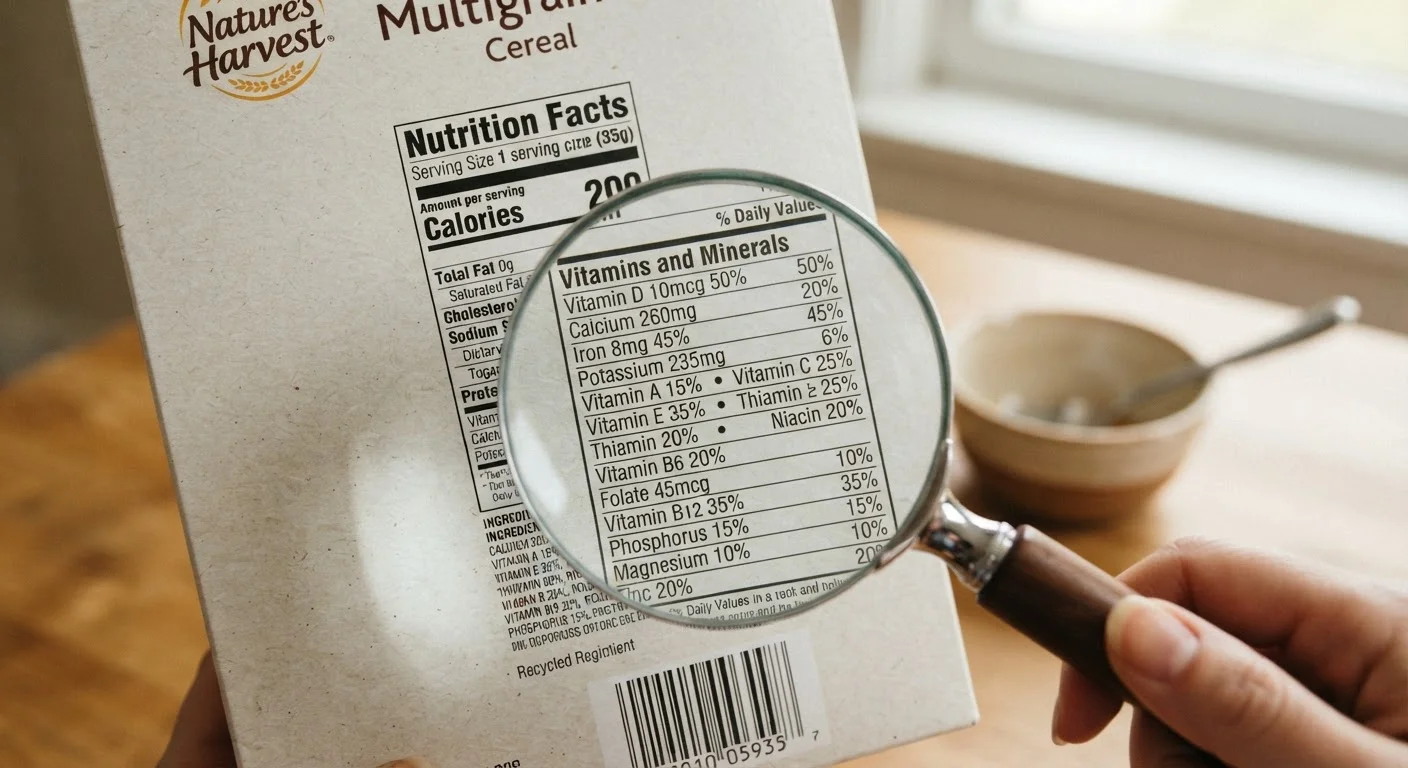
Find the black-and-white Nutrition Facts box on the food package — typically on the back or side. Scroll past the calories and macronutrients (fat, carbohydrates, protein) until you reach the micronutrient section near the bottom, usually separated by a thin horizontal line.
Check the serving size first
Before interpreting any percentage, confirm the serving size listed at the very top of the panel. All %DV figures apply to that specific serving amount — not the entire package. If you eat twice the serving size, you receive twice the %DV for every nutrient listed.
Read each micronutrient's %DV
Review the required nutrients — Vitamin D, Calcium, Iron, and Potassium — and any additional ones listed voluntarily. Note each percentage. Remember: 5% or less is low, 20% or more is high. A food providing 15% DV of calcium contributes a meaningful share of your day's needs from one serving.
Compare products using %DV
Place two similar products side by side — or recall figures from memory while shopping. Use %DV to determine which option delivers more of a nutrient you want. This works best when the serving sizes are similar. Our practical nutrition label walkthrough covers the full comparison approach in detail.
Track micronutrients across the full day
No single food needs to supply 100% of any nutrient. Add up your %DV intake across meals and snacks throughout the day. Aiming for totals near or above 100% for key nutrients like Vitamin D, calcium, and iron — when considered across your whole diet — is the practical goal of using these labels.
This article is for general informational and educational purposes only. It is not a substitute for professional medical or dietary advice. Individual nutrient needs vary. Please consult a registered dietitian or qualified healthcare provider for guidance tailored to your personal health situation.