

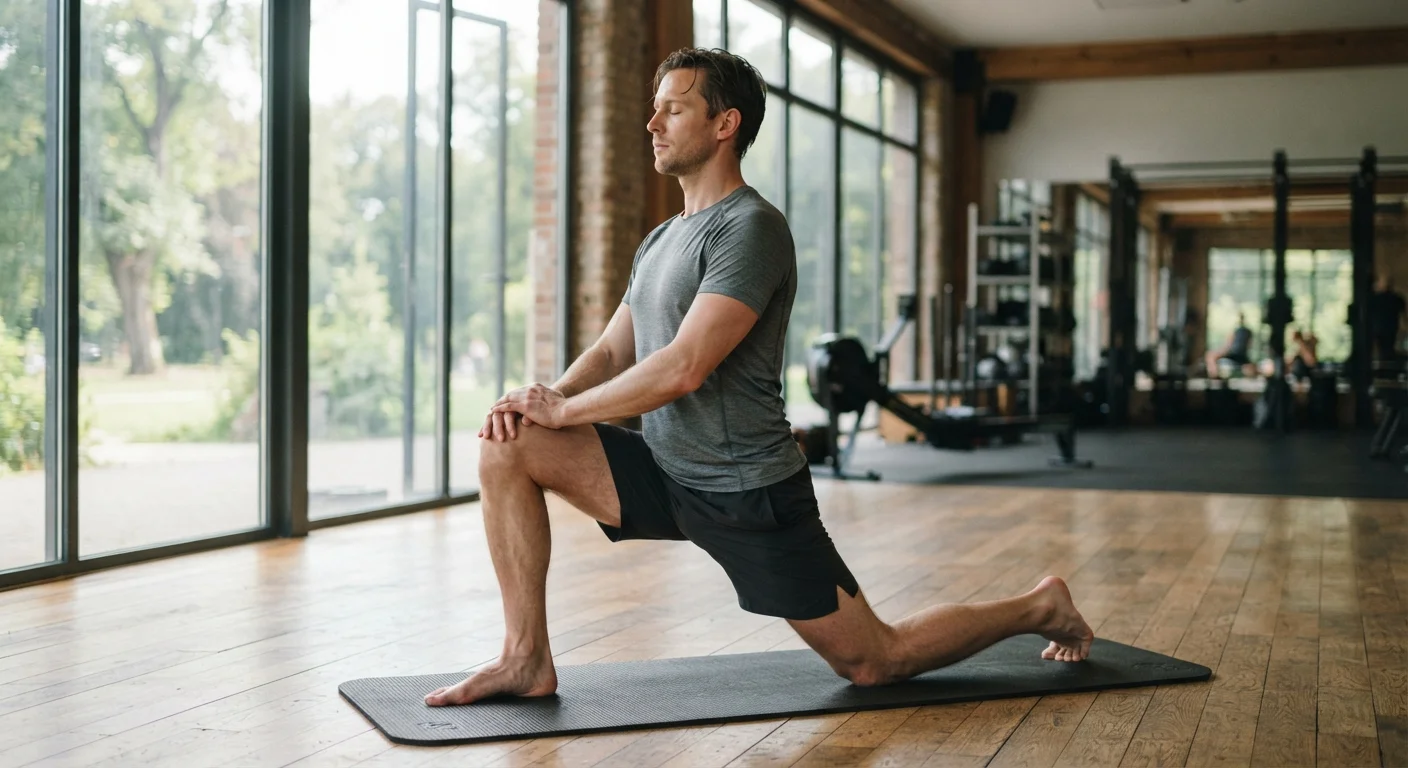
Key Takeaways
Why Mobility Gets Left Out
Walk into almost any commercial gym and you will find a clear hierarchy: weights get the floor space, cardio machines line the walls, and a small stretch mat is tucked in the corner. For many men, mobility work feels optional — something to do if there is time left over. There usually isn't.
That imbalance has real consequences. Reduced range of motion, tight hip flexors from prolonged sitting, and stiff thoracic spines are among the most common physical complaints men bring to physiotherapists. Many of these issues trace back not to insufficient strength but to neglected flexibility and joint mobility. To understand how mobility fits alongside other training types, see our overview of what each exercise category actually does.
The good news is that mobility training doesn't require a complete programme overhaul. Small, deliberate additions to an existing routine can produce meaningful physical improvements — and the benefits go well beyond simply feeling less stiff.
Reduced injury risk during strength and cardio training
One of the clearest benefits of regular mobility work is a lower likelihood of common training injuries. When joints move through a full, controlled range of motion, surrounding muscles are better prepared to absorb load and manage force. Restricted hip mobility, for example, places compensatory stress on the lower back during squats or deadlifts — a pattern that frequently leads to strain over time.
Mobility training isn't a guarantee against injury, but it addresses one of the root causes: poor movement mechanics driven by tightness or restricted range. This makes it particularly valuable for men who train regularly but skip the warm-up and cool-down phases where mobility work typically belongs.
Restricted joint range of motion is a root cause of many common training injuries.
Better posture and spinal health
Prolonged sitting — whether at a desk, in a car, or on a sofa — shortens hip flexors and tightens the chest while weakening the muscles that hold the spine upright. Over time, this creates a characteristic forward lean and rounded upper back that many men notice only once discomfort sets in.
Targeted mobility work — including thoracic rotations, chest openers, and hip flexor stretches — can gradually counteract these postural patterns. Improved spinal alignment also reduces the compressive load on intervertebral discs, which is particularly relevant for men over 40 whose spinal structures become less resilient with age.
Daily sitting shortens hip flexors and rounds posture — mobility work directly counters this pattern.
Improved strength and athletic performance
A muscle that can move through its full range is a muscle that can generate force across more positions. Research in exercise science consistently shows that adequate mobility supports strength gains, not just comfort. A lifter who cannot achieve proper depth in a squat, or full shoulder flexion in an overhead press, is leaving performance on the table.
This principle applies beyond the gym. Mobility supports the functional movement patterns used in sport, recreational activity, and everyday tasks — carrying, climbing, rotating, and reaching. For men interested in how different training modes compare, aerobic vs. resistance training for long-term health covers the complementary benefits of each approach.
A muscle that moves through its full range generates force across more positions — including under load.
Faster recovery between training sessions
Active recovery — gentle movement, stretching, and mobility drills — promotes blood flow to muscle tissue without adding significant stress to the nervous system. This circulation helps clear metabolic by-products that accumulate during intense training and supports the delivery of nutrients to recovering tissue.
Men who incorporate even brief mobility sessions on rest days often report less muscle soreness and a greater readiness to train again sooner. This isn't about pushing harder; it's about helping the body reset more efficiently between efforts.
Gentle mobility work on rest days promotes circulation and helps the body recover more efficiently.
Long-term joint health and functional independence
Joints are kept healthy partly by the movement of synovial fluid — a natural lubricant that distributes through the joint capsule during motion. Sedentary habits reduce this circulation, contributing to stiffness and, over time, increased wear on cartilage. Regular mobility training keeps joints moving through their intended range, supporting the conditions that joint tissue needs to remain healthy.
For older men in particular, maintaining functional range of motion is directly tied to independence — the ability to get up from the floor, carry objects, or reach overhead without pain or assistance. Starting mobility habits earlier makes that long-term picture significantly more achievable.
Regular joint movement circulates synovial fluid, supporting cartilage health and long-term physical independence.
Building It Into Your Routine
Mobility work doesn't demand a standalone hour-long session. A 10-to-15-minute block before or after training — or even spread through the day — is enough to see progress over weeks and months. Consistency matters far more than duration.
Start Small and Stay Consistent
You don't need a dedicated mobility class to see results. Begin with five minutes of hip flexor stretches and thoracic rotations added to your existing warm-up. Aim to do this consistently for three to four weeks before expanding the routine. Small, regular sessions build far more lasting range of motion than occasional long ones.
It is also worth knowing that how well you move is closely tied to how well you recover. Hydration and physical performance are more connected than most people realise, and adequate fluid intake supports the joint lubrication and muscle pliability that mobility work depends on. For a broader view of why flexibility training is consistently undervalued, this article on what you lose without it lays out the research clearly.
This article is for general informational purposes only and does not constitute medical advice. If you have existing joint problems, injuries, or chronic conditions, consult a qualified healthcare professional before starting a new exercise programme.