

| Common beginner rep range | 8-12 reps per set (American College of Sports Medicine (ACSM) general strength guidelines) |
| Recommended rest days per week | At least 1-2 days (ACSM exercise recommendations for general fitness) |
| Typical HIIT workout duration | 20-30 minutes (General exercise science guidance) |
| RPE scale range | 1 (no effort) to 10 (maximum effort) (Borg RPE scale, adapted for 1-10 format) |
| DOMS peak onset | 24-72 hours post-exercise (National Strength and Conditioning Association (NSCA)) |
Why Fitness Vocabulary Matters for Beginners
Walking into a gym or opening a workout app for the first time can feel overwhelming - not because the exercises are impossible, but because the language used to describe them is unfamiliar. Terms like progressive overload, RPE, and compound movement get thrown around as if everyone already knows what they mean.
They don't - and that's completely normal. Understanding the basic vocabulary of fitness helps you follow instructions confidently, ask better questions, and avoid misinterpreting guidance in ways that could lead to injury or frustration. This quick-reference glossary covers the terms you're most likely to encounter as a beginner.
For a broader foundation, see our complete beginner's guide to exercise and movement. And if you want to explore how these terms apply to specific training styles, our workout types overview is a helpful next stop.
This Is General Information, Not Personal Advice
The definitions and guidance in this article are for educational purposes only and are not a substitute for professional instruction. If you have an existing health condition, injury, or are new to exercise after a long break, consult a qualified healthcare provider or certified fitness professional before beginning any training program.
Core Training Terms: Reps, Sets, and Load
These three concepts form the foundation of almost every structured workout program.
| Common beginner rep range | 8-12 reps per set (American College of Sports Medicine (ACSM) general strength guidelines) |
| Recommended rest days per week | At least 1-2 days (ACSM exercise recommendations for general fitness) |
| Typical HIIT workout duration | 20-30 minutes (General exercise science guidance) |
| RPE scale range | 1 (no effort) to 10 (maximum effort) (Borg RPE scale, adapted for 1-10 format) |
| DOMS peak onset | 24-72 hours post-exercise (National Strength and Conditioning Association (NSCA)) |
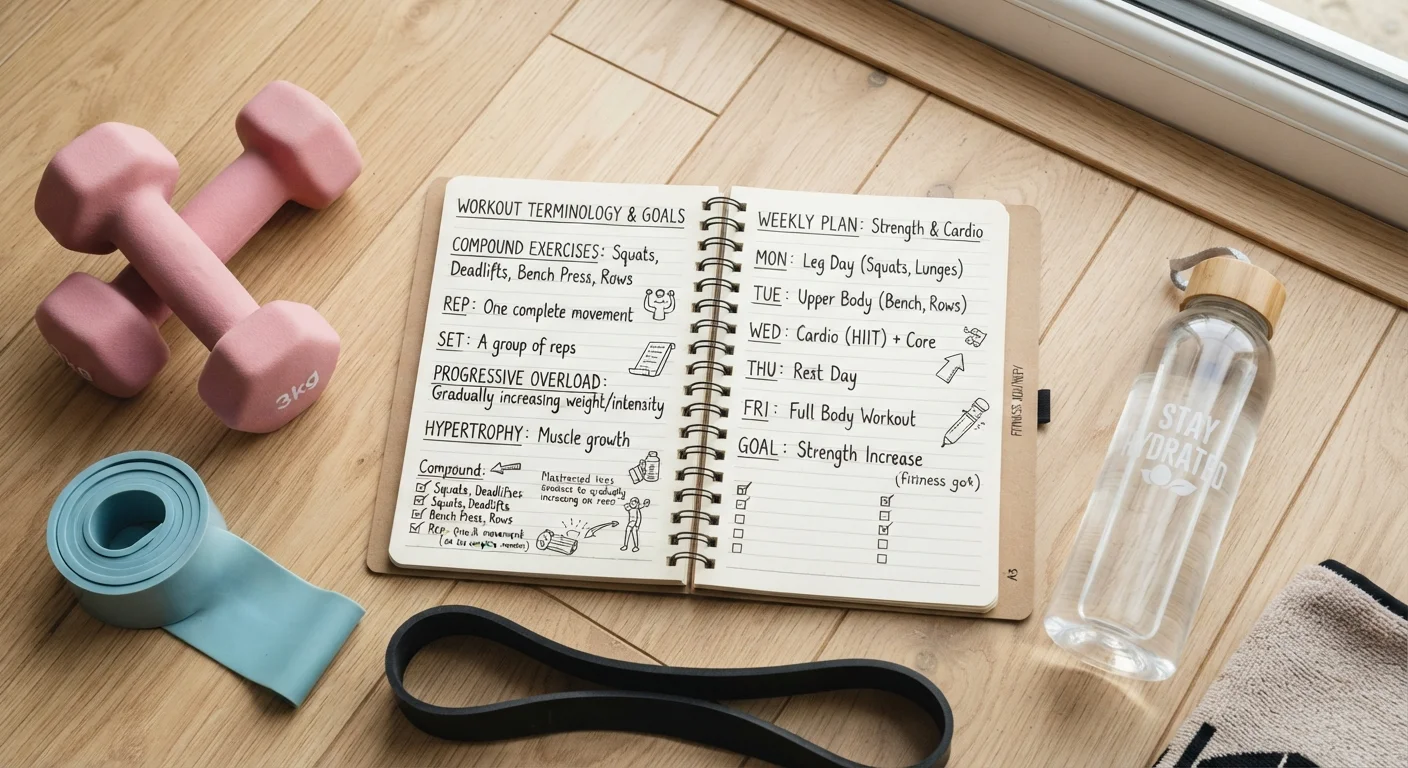
- Rep - One complete movement cycle of an exercise.
- Set - A group of reps performed consecutively before resting.
- Rest Interval - The time you take to recover between sets. Longer rests (2-3 minutes) support heavier strength work; shorter rests (30-60 seconds) maintain intensity in circuit-style training.
- Progressive Overload - The principle of gradually increasing workout difficulty over time. This is how your body is prompted to grow stronger and more capable. Without it, progress stalls.
Understanding these terms makes any program - whether written or video-based - much easier to follow. You can also explore how common misconceptions around these concepts affect beginners in our article on fitness myths that hold beginners back.
Cardio and Intensity Terms
Cardiovascular training has its own language - particularly around intensity and format. These are the terms you'll encounter most.
8-12
Reps per set for beginner strength training
The ACSM recommends this rep range as an effective starting point for building muscular strength and endurance in untrained individuals.
150 min
Weekly moderate-intensity cardio target
U.S. Department of Health and Human Services Physical Activity Guidelines recommend at least 150 minutes of moderate aerobic activity per week for adults.
- HIIT (High-Intensity Interval Training) - Alternating short, hard-effort bursts with brief rest periods. Effective and time-efficient, but demanding on the body - beginners should build a base level of fitness before adding frequent HIIT sessions.
- LISS (Low-Intensity Steady-State) - Sustained, comfortable-effort cardio like walking or easy cycling. Easier to recover from and a good foundation for new exercisers.
- RPE (Rate of Perceived Exertion) - A self-rating of how hard you feel you're working on a scale of 1-10. A brisk walk might feel like a 4; a sprint, closer to a 9. RPE helps you regulate effort without needing a heart rate monitor.
For a deeper look at these cardio formats and when to use each, see our plain-language guide to HIIT, LISS, and steady-state cardio.
Movement Types and Recovery Essentials
Knowing what kind of exercise you're doing - and how to recover from it - rounds out the beginner vocabulary you need.
Recovery is where fitness gains actually take root. Rest intervals, sleep, and dedicated rest days allow the micro-adaptations triggered by exercise to occur. Skipping recovery consistently increases injury risk and can stall progress. For a full overview of why rest matters, see our complete guide to recovery and rest for beginners.
You may also find it useful to compare this glossary with our plain-language workout terms glossary, which covers additional concepts like VO2 max in more depth.
This article is for informational and educational purposes only and does not constitute medical or professional fitness advice. Always consult a qualified healthcare provider or certified fitness professional before beginning a new exercise program, especially if you have any underlying health conditions or injuries.