
Everything a Fitness Beginner Needs to Understand About Exercise, Movement, and Progress

Key Takeaways
Why Movement Matters From Day One
If you're new to fitness, the most important thing to know is this: you don't need to be fit to start exercising. Regular physical activity supports nearly every system in the body - cardiovascular health, bone density, mood regulation, sleep quality, and metabolic function - and these benefits begin accumulating from your very first session.
According to the American College of Sports Medicine (ACSM), adults benefit from as little as 150 minutes of moderate-intensity movement per week. That's roughly 20-30 minutes most days. The bar for a meaningful start is lower than most beginners assume.
The real enemy of progress isn't a lack of perfect equipment or an elite program - it's inaction driven by overwhelm. This guide is designed to eliminate that overwhelm by giving you a clear, honest map of what exercise is, how it works, and how to build habits that last.
This Is Education, Not Medical Advice
The information in this article is intended for general educational purposes only. It is not a substitute for personalized guidance from a qualified healthcare provider or certified fitness professional. If you have any health conditions, injuries, or concerns, consult a professional before beginning or modifying an exercise program.
This article is for general informational and educational purposes only. It is not a substitute for personalized medical advice. Consult a qualified healthcare professional before beginning any new exercise program, especially if you have existing health conditions or have been inactive for an extended period.
Understanding the Main Types of Exercise
Exercise isn't one thing - it's a family of different movement types, each with distinct effects on the body. A well-rounded beginner program draws from all of them. See the Workout Types hub for a deeper breakdown of each category.
Cardiovascular (Aerobic) Exercise
Activities like walking, jogging, cycling, and swimming that elevate your heart rate for a sustained period. Cardio trains your heart and lungs, improves circulation, and builds aerobic endurance - your body's ability to sustain effort over time.
Strength (Resistance) Training
Using bodyweight, free weights, or resistance bands to challenge your muscles against load. Strength training builds muscle tissue, increases bone density, and raises your resting metabolic rate. Beginners can make significant strength gains using nothing but their own bodyweight.
Flexibility and Mobility Work
Stretching, yoga, and mobility drills improve your range of motion, reduce injury risk, and help muscles recover between sessions. Often overlooked by beginners, flexibility work pays dividends in every other area of fitness.
Balance and Stability Training
Single-leg stands, core-focused movements, and stability exercises improve neuromuscular coordination - your nervous system's ability to control your body in space. This becomes increasingly important for injury prevention as training intensity rises.
150 min
Weekly moderate activity recommended for adults
According to the American College of Sports Medicine (ACSM) and the U.S. Department of Health and Human Services Physical Activity Guidelines.
2-4 weeks
Time for early neurological strength adaptations to appear
Exercise physiology research consistently shows novice exercisers experience neural efficiency gains within the first few weeks of resistance training.
3 days/week
Minimum frequency for beginner strength training gains
The NSCA recommends 2-3 days per week of resistance training for novice exercisers seeking foundational strength development.
Building Your First Beginner Routine
A beginner routine doesn't need to be complicated. In fact, simplicity is an advantage - it lowers the friction that causes people to quit. The following framework is grounded in ACSM and NSCA (National Strength and Conditioning Association) guidelines for novice exercisers.
- Frequency: Aim for 3 days of structured movement per week, with rest or light activity on alternate days.
- Duration: Start with 20-30 minutes per session. Consistency matters more than length at this stage.
- Exercise selection: Focus on compound movements that work multiple muscle groups simultaneously - squats, hinges (like deadlifts), pushes (like push-ups), and pulls (like rows).
- Intensity: You should feel challenged but able to hold a conversation. If you can't speak, slow down.
Choose exercises you can perform with good form before adding resistance or speed. A perfectly executed bodyweight squat builds more strength and safety than a loaded squat done sloppily.
Form breakdowns are the most common source of beginner injuries. Movement quality is the foundation that every other training variable is built on.
Log your workouts in a simple notes app after every session - just the exercises, sets, reps, and how you felt. Reviewing two weeks of entries is often the most motivating thing a beginner can do.
Tracking creates objective evidence of progress that counters the perception that 'nothing is changing,' which is one of the leading causes of early dropout.
A sample beginner week might include two full-body strength sessions using bodyweight (squats, push-ups, glute bridges, and a plank hold) plus one 25-minute brisk walk. That's an entirely legitimate starting point - and a strong one.
Special populations - including pregnant individuals, older adults, and those managing chronic conditions - should consult a healthcare provider or certified exercise professional before designing a routine.
Start With What You Have
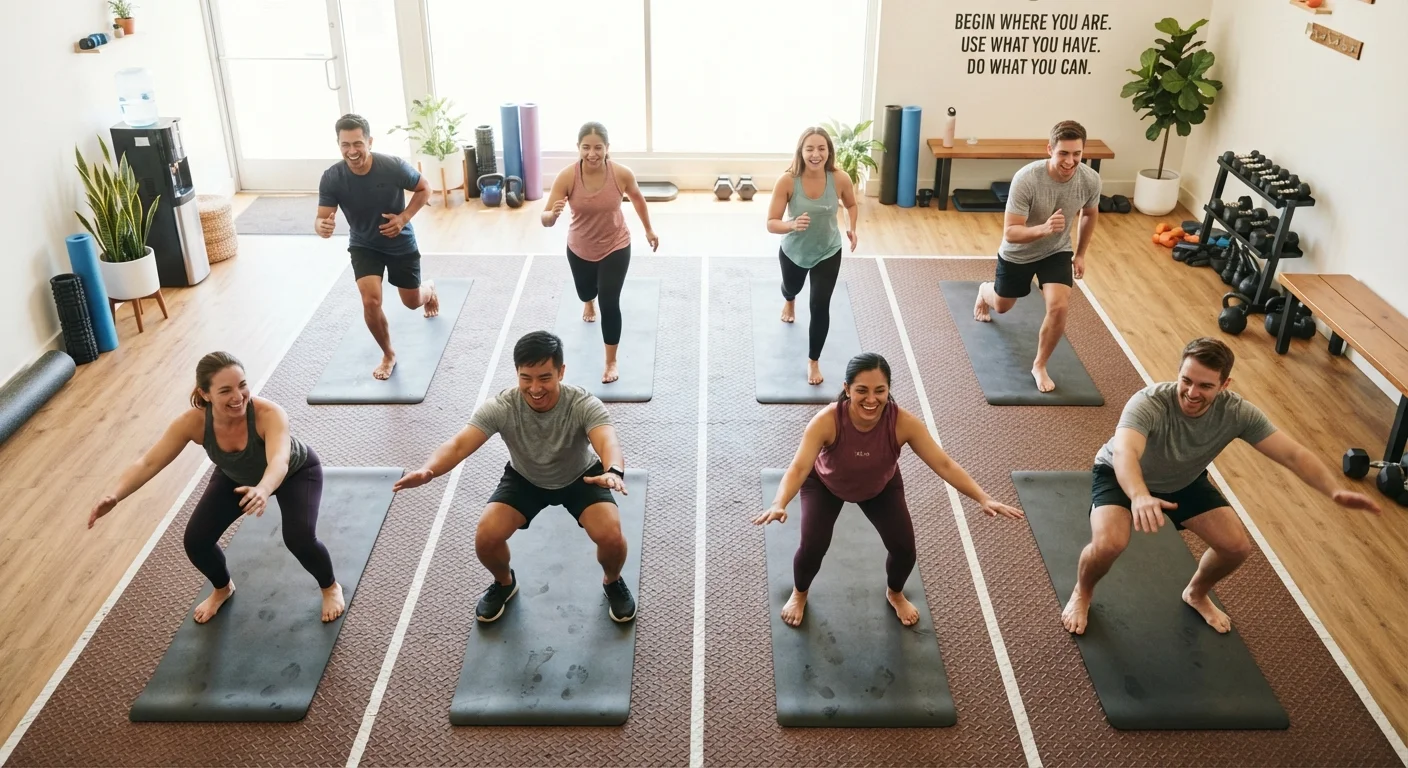
You do not need a gym membership or equipment to begin. Bodyweight exercises performed consistently at home - squats, push-ups, lunges, and planks - can deliver meaningful strength and fitness improvements for months. Barriers to starting should be as low as possible.
How Progress Actually Works
Many beginners expect rapid visible changes and feel discouraged when they don't appear immediately. Understanding the physiology of adaptation makes progress feel more predictable - and more sustainable.
The central mechanism behind all fitness improvement is progressive overload - systematically increasing the demand placed on your body over time. This can mean adding one more repetition, reducing rest time by 10 seconds, or attempting a slightly more challenging variation of an exercise. Small, consistent increments compound into significant changes over weeks and months.
Early gains for beginners are largely neurological: your nervous system learns to recruit muscle fibers more efficiently before visible muscle growth begins. This is why beginners often feel stronger and more coordinated within the first few weeks, even before their physique changes noticeably.
“Progressive overload is the cornerstone of all training adaptation. Without a systematic increase in demand, the body has no reason to change.”
— Brad Schoenfeld, Exercise scientist and researcher specializing in muscle hypertrophy
Tracking your sessions - even informally in a notes app - lets you see this accumulation of effort clearly. Noting what you did, how it felt, and what you'll try to improve next time is one of the most underrated tools a beginner has.
Recovery, Nutrition, and the Bigger Picture
Exercise is a stimulus. Adaptation - getting stronger, more enduring, more mobile - happens during rest. Skipping recovery doesn't accelerate progress; it stalls or reverses it. The Recovery & Rest hub and the companion article Recovery & Rest: A Complete Overview for Fitness Beginners explain this in depth, but the essentials are: prioritize 7-9 hours of sleep, schedule at least 1-2 full rest days per week, and treat soreness as information rather than a badge of honor.
Nutrition is the other half of the equation. You don't need a rigid meal plan to support a beginner fitness routine, but being aware of basic principles - adequate protein intake, hydration, and eating enough to fuel activity - makes a meaningful difference. The Nutrition from First Principles guide is an excellent starting point, as is Your First Steps Toward Eating More Nutritiously.
Don't Ignore Persistent Pain
Muscle soreness (a dull ache that peaks 24-48 hours after exercise) is normal and expected. Sharp, acute, or joint-localized pain during or after exercise is not. If you experience the latter, stop the activity and consult a healthcare professional before continuing. Training through true pain - as opposed to general effort discomfort - increases injury risk significantly.
Fitness is a lifelong practice, not a 30-day fix. The goal at the beginning isn't transformation - it's repetition. Every session you complete builds the neural pathways, physical capacity, and self-efficacy that make the next session easier. Start small, stay consistent, and trust the process.
This article is for informational purposes only and is not medical advice. Always consult a qualified healthcare professional before starting a new exercise program.
ACSM Exercise Guidelines for Beginners
The American College of Sports Medicine publishes evidence-based physical activity guidelines for adults at all fitness levels. A reliable reference for understanding recommended exercise frequency, intensity, and duration.
Recovery & Rest: A Complete Overview for Fitness Beginners
A science-backed companion resource covering rest days, sleep, soreness, and recovery techniques - everything a beginner needs to understand about how the body rebuilds after exercise.
Workout Types Hub
An overview of all major exercise categories - strength, cardio, flexibility, and more - explaining what each type does for your body and how they fit into a balanced routine.