

Key Takeaways
Start here
What Mindfulness Actually Means
Understand the why
What the Research Says
Try it now
Your First Mindfulness Exercise
Troubleshoot
Common Beginner Struggles (and What to Do)
Keep going
Building From Here
What Mindfulness Actually Means
The word mindfulness gets used so often that its meaning can feel slippery. At its core, mindfulness means paying deliberate, non-judgmental attention to what is happening right now — in your body, your thoughts, and your surroundings — without trying to change or evaluate it.
Mindfulness
Intentional, non-judgmental awareness of the present moment — including thoughts, feelings, and physical sensations — without trying to change them.
Anchor breath
Using the physical sensation of breathing as a focus point to bring attention back to the present whenever the mind wanders.
Non-judgment
Observing your thoughts and feelings as they are, without labeling them as good, bad, or problems to solve.
MBSR
Mindfulness-Based Stress Reduction — a structured eight-week program developed by Jon Kabat-Zinn that uses mindfulness meditation to support stress management.
Present-moment awareness
Attention directed to what is actually happening right now, rather than replaying the past or anticipating the future.
That's it. No special posture required. No clearing your mind of every thought. No achieving a blissful state. The practice is simply noticing — the feeling of your feet on the floor, the rhythm of your breath, a sound in the room — and doing so with a quality of openness rather than criticism.
This idea is drawn from ancient contemplative traditions, but over recent decades it has been studied extensively in clinical and psychological research settings, leading to structured programs like Mindfulness-Based Stress Reduction (MBSR) and Mindfulness-Based Cognitive Therapy (MBCT).
What the Research Says
You don't need to take mindfulness on faith. A substantial body of peer-reviewed research supports its potential benefits for mental well-being. Studies published in journals such as JAMA Internal Medicine and Psychological Science have found associations between regular mindfulness practice and reductions in perceived stress, anxiety symptoms, and low mood.
Importantly, researchers note that benefits appear to build gradually with consistent practice rather than arriving after a single session. The mechanism most often discussed is a shift in how you relate to difficult thoughts and feelings — observing them without being automatically swept along by them.
Mindfulness is a complement, not a cure
Research supports mindfulness as a tool for general mental wellness, but it is not a replacement for professional mental health care. If you are living with a diagnosed condition such as depression, anxiety disorder, or PTSD, speak with a healthcare provider before starting a new practice. They can help you determine whether and how mindfulness fits into your overall care.
This is general health information, not medical advice. Individual experiences vary, and mindfulness is not a treatment for clinical conditions. If you are managing a diagnosed mental health condition, please speak with a qualified professional before beginning any new practice.
Your First Mindfulness Exercise
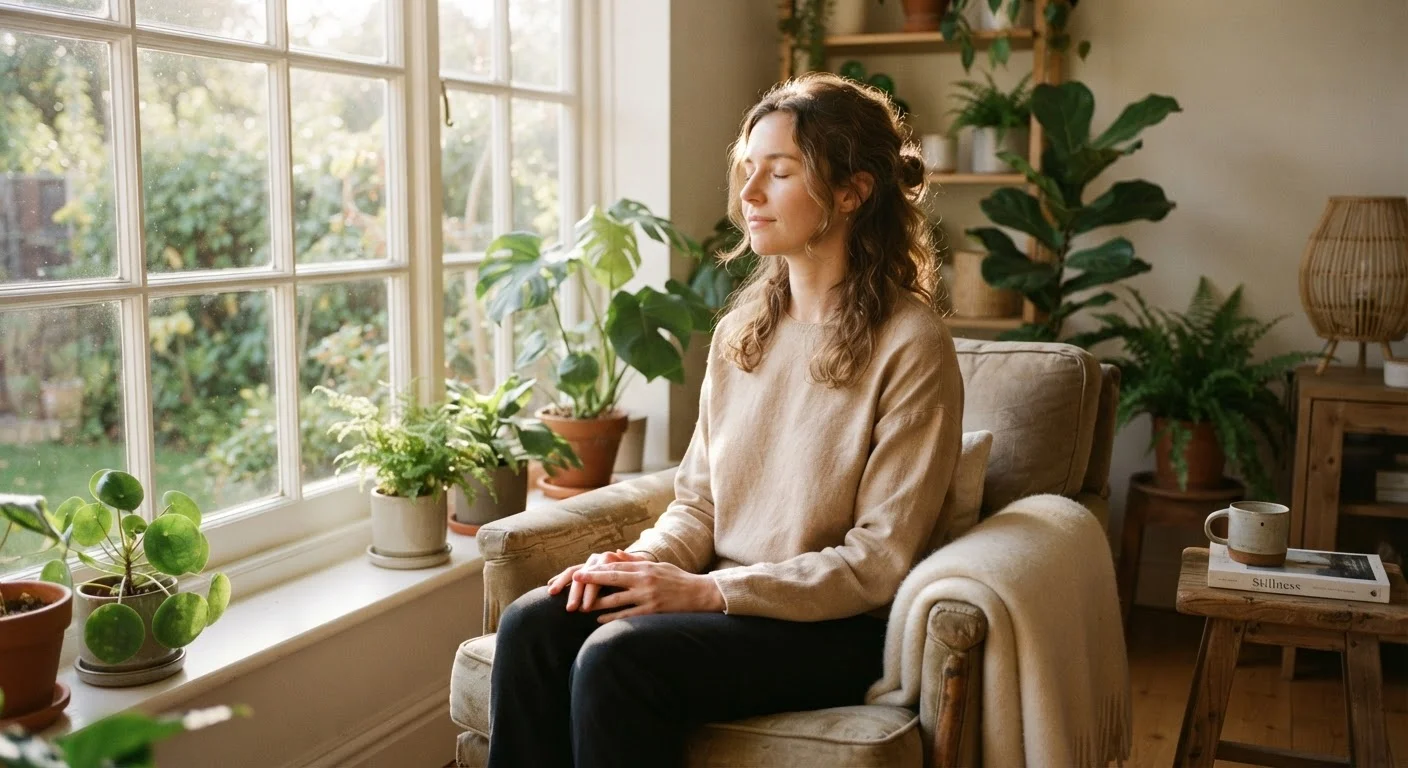
The anchor breath technique is one of the most beginner-friendly entry points into mindfulness. Here's how to try it right now:
- Find a comfortable position. Sit in a chair with your feet flat on the floor, or sit cross-legged — whatever feels natural. You don't need to be still or rigid.
- Set a gentle timer for two to five minutes. This removes the need to watch the clock.
- Direct your attention to your breath. Notice the physical sensation of each inhale and exhale — the air at your nostrils, the rise and fall of your chest or belly.
- When your mind wanders, gently return. You will notice thoughts arising. That is expected. Simply acknowledge them — thinking — and guide your attention back to the breath without self-criticism.
- Close gently. When your timer sounds, take one slow breath before resuming your day.
Imperfect practice still counts
You don't need a quiet room, a cushion, or a calm mind to begin. Practicing in a noisy environment with a restless mind is still practicing. What matters is showing up with the intention to pay attention, not achieving any particular inner state.
That's one complete session. It may feel unremarkable the first time, and that is perfectly fine. The value accumulates over repetition, not intensity.
Common Beginner Struggles (and What to Do)
Most beginners encounter the same handful of obstacles. Recognising them ahead of time can save a lot of frustration.
- "My mind won't stop."
- This is not a problem to fix — it is the practice itself. Every time you notice the mind has moved and return your attention, you are doing exactly what mindfulness asks of you.
- "I don't have time."
- Two minutes counts. Mindfulness can also be woven into things you already do. Our article on mindful moments in everyday life explores how to find these micro-opportunities without adding anything to your schedule.
- "I don't know if I'm doing it right."
- If you are paying attention on purpose and returning when you drift, you are doing it right. There is no performance to evaluate. If you'd prefer more structure, guided practice options may feel more reassuring.
- "It feels uncomfortable."
- Sitting with your inner experience can occasionally surface feelings that seem unexpected. If discomfort becomes distressing, stop and return at another time. For some individuals, certain practices warrant extra care — our article on when to seek guidance first provides helpful context.
Building From Here
Starting is genuinely the hardest part. Once you've tried even a single two-minute session, you've crossed the most significant threshold. From here, the aim is to practice with enough regularity that it becomes a natural part of your week — not a chore you have to remember.
Our guide to building a short daily mindfulness routine offers a practical, schedule-friendly framework for making this stick. If you're exploring other approaches to mental wellness alongside mindfulness, you might also find value in starting therapy or in the reflective practice of journaling for mental well-being.
Building a Short Daily Mindfulness Routine
A practical, step-by-step framework for establishing a realistic daily mindfulness habit — designed around real schedules, not ideal ones.
Mindful Moments: Small Practices for Ordinary Days
Explore how to integrate mindfulness into everyday activities — from morning coffee to commuting — without needing a dedicated session.
Guided vs. Unguided Mindfulness Practice
Compare both approaches to mindfulness and discover which style might suit your personality, schedule, and goals.
Wherever you go next, know that beginning — imperfectly, briefly, without certainty — is always enough.
This article is for informational and educational purposes only and does not constitute medical advice. Please consult a qualified healthcare professional for guidance specific to your health circumstances.