

Key Takeaways
Option A
Breath-Focused Meditation
The single-point anchor for a wandering mind.
Best for: People seeking a straightforward, portable technique to settle racing thoughts and build concentration.
Option B
Body-Scan Meditation
The head-to-toe check-in for deeper self-awareness.
Best for: People who want to release physical tension, reconnect with bodily sensations, or unwind before sleep.
If you want to quiet anxious or racing thoughts quickly
Breath-Focused Meditation
Anchoring attention to the breath interrupts thought spirals and is easy to practice anywhere, even at a desk or on a commute.
If you carry physical tension or struggle to wind down at night
Body-Scan Meditation
Systematically moving awareness through the body helps identify and soften areas of held tension, making it especially useful before sleep.
If you are entirely new to meditation and want the simplest starting point
Breath-Focused Meditation
One clear focal point makes it easier for beginners to understand the core skill of returning attention when the mind drifts.
If you feel disconnected from your body or are working through chronic stress
Body-Scan Meditation
Gently re-establishing contact with bodily sensations can support emotional regulation and help rebuild a sense of safety in the body over time.
What Each Technique Actually Involves
Before choosing between these two practices, it helps to understand what each one asks of you. Both are forms of mindfulness meditation — meaning both involve paying deliberate, non-judgmental attention to present-moment experience. If you are new to these terms, our article on the difference between mindfulness and meditation is a useful starting point.
Breath-Focused Meditation
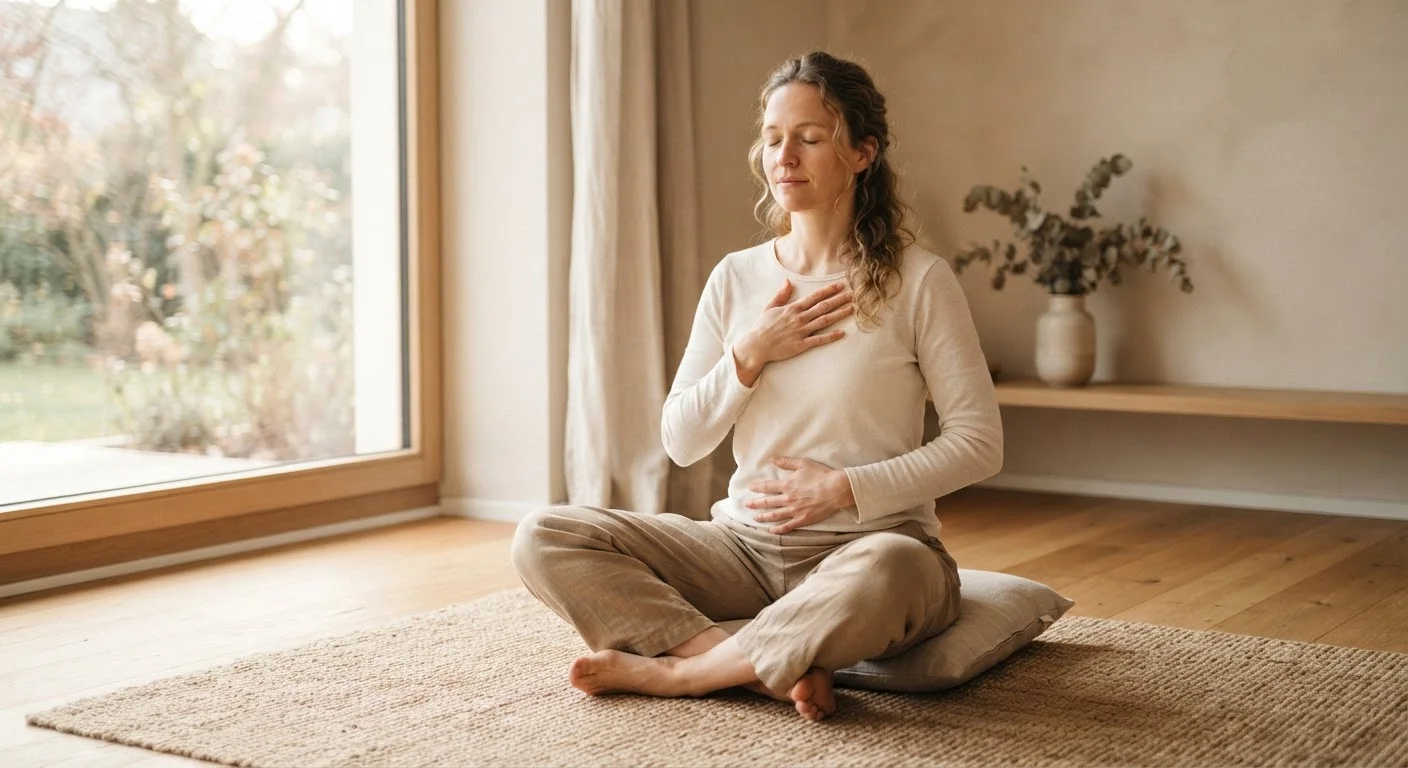
In breath-focused meditation, you choose one aspect of breathing as your anchor — the rise and fall of your chest, the sensation of air passing through your nostrils, or the natural pause between inhale and exhale. Whenever your mind wanders (and it will), you gently redirect attention back to that anchor. The practice is less about controlling the breath and more about noticing it with curiosity. Sessions can range from five minutes to half an hour or more.
Body-Scan Meditation
Body-scan meditation involves moving your attention slowly and systematically from one region of the body to another — commonly starting at the top of the head or the soles of the feet and traveling in a deliberate sequence. You observe whatever sensations are present: warmth, tightness, tingling, numbness, or simply nothing at all. The goal is observation, not relaxation, though relaxation often follows naturally. Body scans are typically longer, ranging from ten to forty-five minutes in formal clinical programs such as Mindfulness-Based Stress Reduction (MBSR).
| Criterion | Breath-Focused Meditation | Body-Scan Meditation |
|---|---|---|
| Primary focus | Single anchor: the breath | Sequential body regions |
| Typical session length | 5–30 minutes | 10–45 minutes |
| Best posture | Seated, standing, or walking | Lying down or fully reclined |
| Core mental skill | Focused, sustained attention | Open, roving awareness |
| Primary benefit studied | Reduced mind-wandering and anxiety | Stress reduction and body awareness |
| Portability | Highly portable — usable anywhere | Requires quiet, uninterrupted space |
| Common clinical use | Mindfulness-Based Cognitive Therapy (MBCT) | Mindfulness-Based Stress Reduction (MBSR) |
The Science Behind Each Approach
Both techniques have been studied in clinical and research settings, though the evidence base varies in depth and scope.
Breath-focused practices are among the most researched forms of meditation. Studies published in journals such as Frontiers in Human Neuroscience suggest that focused-attention meditation — of which breath awareness is a primary example — is associated with improvements in sustained attention, reduced mind-wandering, and lower self-reported anxiety. It is widely used as a foundational skill in Mindfulness-Based Cognitive Therapy (MBCT), a clinically validated approach for reducing relapse in recurrent depression.
Body-scan meditation has been a core component of Jon Kabat-Zinn's MBSR program since its development at the University of Massachusetts in the late 1970s. Research on MBSR suggests benefits for perceived stress, sleep quality, and chronic pain management, though it is important to note that most studies measure the full MBSR program rather than the body scan in isolation. Emerging research also points to its potential for supporting interoception — the ability to perceive internal bodily states — which is thought to play a role in emotional regulation.
8 weeks
Typical MBSR program duration
Jon Kabat-Zinn's Mindfulness-Based Stress Reduction program, which prominently features body-scan practice, is structured as an eight-week course used in clinical and community settings.
~47%
Time the mind typically wanders
A Harvard University study published in Science found that people's minds are wandering nearly half of waking hours — a key reason focused-attention practices like breath meditation are of clinical interest.
For a broader look at how these practices fit within different traditions, see our quick reference on mindfulness across traditions.
Practical Differences and How to Choose
Knowing the theory is one thing; integrating a practice into daily life is another. Here are some practical distinctions worth considering.
- Time and posture: Breath meditation is highly flexible — you can practice seated, standing, or even walking. Body scans are most effective lying down or in a fully supported reclined position, and typically require more uninterrupted time.
- Mental effort: Breath meditation trains a skill sometimes called focused attention — returning again and again to a single point. Body scans cultivate open monitoring — a broader, roving awareness that notices without fixing on any one thing.
- Emotional content: Body scans can sometimes surface unexpected emotions as attention moves into areas of stored tension. This is generally considered a healthy part of the process, but if you are navigating significant trauma or anxiety, working with a trained instructor or therapist is advisable.
If you are weighing whether to practice in a structured session versus weaving mindfulness into daily activities, our comparison of formal meditation vs. everyday mindfulness explores that question in depth. And if you are drawn to breath work beyond sitting meditation, breathwork for beginners offers accessible techniques for calming the nervous system.
Many practitioners find that the two techniques complement each other — using breath awareness for a quick mid-day reset and a body scan to transition into rest at the end of the day. You might also explore guided vs. unguided mindfulness practice to decide whether an audio guide or silent self-direction suits you better.
A Note on Getting Started Safely
Both techniques are generally considered safe for most healthy adults. However, individuals with a history of trauma, panic disorder, or dissociation may find that prolonged internal focus — particularly body scans — occasionally brings up difficult material. If that happens, gently opening your eyes, orienting to the room, and pausing the practice is always appropriate. Working with a qualified mindfulness instructor or mental health professional can provide added support as you build your practice.
This article is for general informational and educational purposes only and is not a substitute for professional medical or mental health advice. If you are experiencing significant anxiety, depression, chronic pain, or trauma, please speak with a qualified healthcare provider before beginning a new meditation practice.