

Key Takeaways
Option A
Asthma
The reversible, often allergy-linked airway condition.
Best for: Understanding a condition that commonly begins in childhood and typically responds well to trigger avoidance and inhaled medication.
Option B
COPD (Chronic Obstructive Pulmonary Disease)
The progressive, largely irreversible lung disease of adulthood.
Best for: Understanding a condition most common in long-term smokers or those with prolonged exposure to lung irritants, requiring ongoing management.
If you experience wheezing triggered by allergens, exercise, or cold air
Asthma
These are hallmark asthma triggers. An allergist or pulmonologist can confirm the diagnosis with lung function tests and guide a management plan.
If you are a current or former smoker with a persistent, productive cough and breathlessness
COPD
These symptoms align closely with COPD. Early spirometry testing can detect airflow limitation before symptoms become severe.
If you have had asthma for years and notice your symptoms are becoming constant rather than episodic
COPD
Long-standing uncontrolled asthma can lead to fixed airflow obstruction. A physician evaluation is important to reassess your diagnosis.
If symptoms seem to fit both conditions - partial reversibility plus smoking history
Asthma
Asthma-COPD Overlap (ACO) is a recognized clinical pattern. A specialist can determine whether elements of both are present and tailor treatment accordingly.
What Are Asthma and COPD?
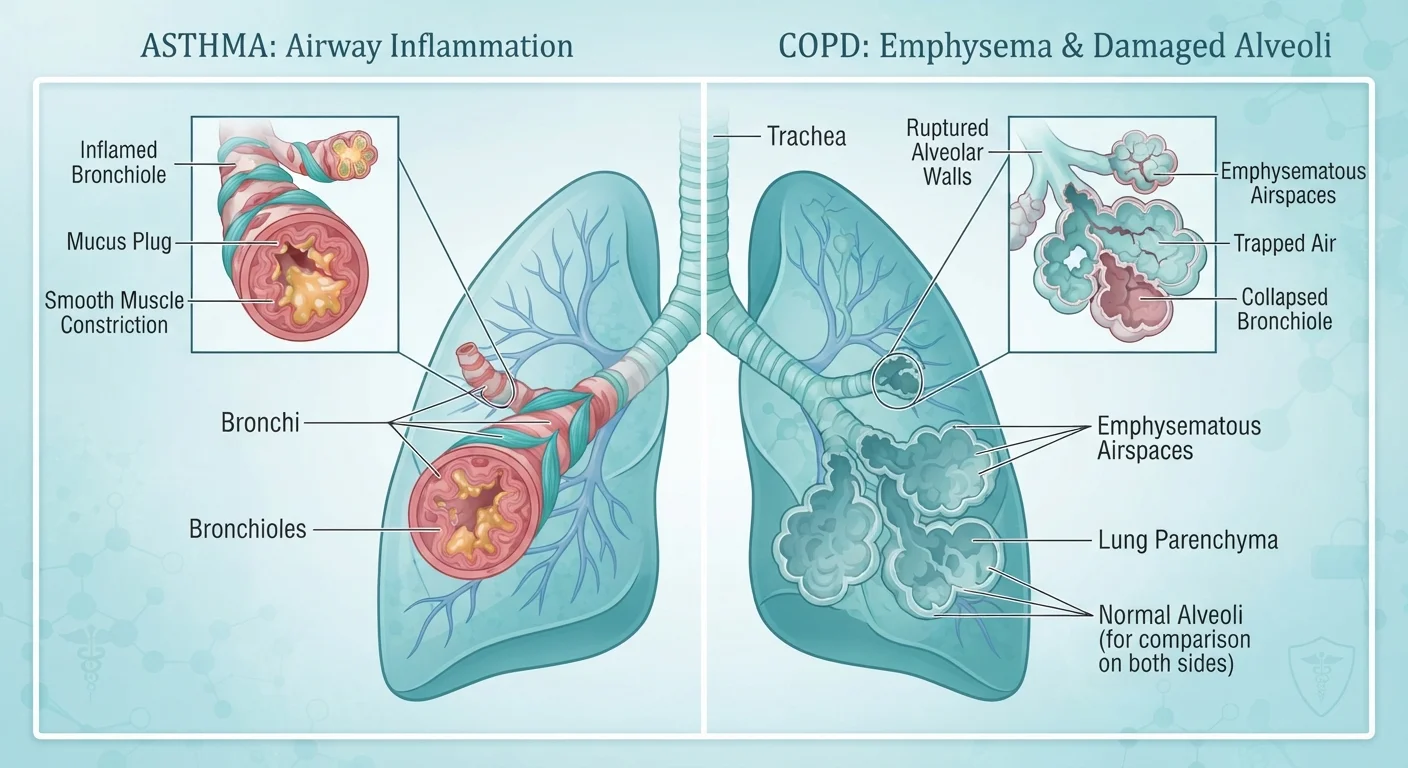
Asthma and COPD are both chronic conditions that affect the airways and make breathing harder than it should be. Despite sharing symptoms - particularly shortness of breath, wheezing, and coughing - they are fundamentally different diseases with different causes, different progression patterns, and different treatment strategies.
Asthma is characterized by inflammation and narrowing of the airways that is typically reversible. The airways overreact to specific triggers - allergens like pollen or pet dander, exercise, cold air, or respiratory infections - causing episodes of tightening and swelling. Between these episodes, lung function often returns to normal.
COPD is an umbrella term covering two main conditions: emphysema (damage to the tiny air sacs in the lungs, called alveoli) and chronic bronchitis (long-term inflammation of the bronchial tubes). Unlike asthma, the airflow limitation in COPD is largely irreversible and tends to worsen gradually over time. According to the CDC, COPD affects approximately 16 million Americans who have received a formal diagnosis - and millions more may have the disease without knowing it.
Just as similar-sounding gut conditions require careful distinction, respiratory conditions demand the same clarity. Much like IBS, IBD, and Crohn's disease can be mistaken for one another, asthma and COPD are frequently confused - with real consequences for care.
Key Differences: Causes, Onset, and Progression
The distinctions between asthma and COPD run deeper than symptoms. Understanding the root causes and typical disease trajectories helps clarify why each condition is managed differently.
| Criterion | Asthma | COPD |
|---|---|---|
| Typical age of onset | Often childhood; any age possible | Usually adults over 40 |
| Primary cause | Genetics, allergies, immune response | Smoking, prolonged irritant exposure |
| Airflow obstruction | Reversible (episodic) | Largely irreversible (persistent) |
| Disease progression | Stable with good management | Progressive decline over time |
| Response to bronchodilator | Significant improvement | Minimal improvement |
| Key symptoms | Episodic wheeze, chest tightness, cough | Chronic cough, sputum, breathlessness |
| Inflammation type | Eosinophilic (allergic-type) | Neutrophilic (irritant-driven) |
Asthma has a strong genetic and allergic component. It most commonly appears in childhood, though adult-onset asthma is well documented. The immune system plays a central role: in asthmatic airways, an exaggerated inflammatory response to triggers causes episodic bronchoconstriction (tightening of the airway muscles).
COPD, by contrast, is overwhelmingly caused by long-term exposure to irritants that damage lung tissue. Cigarette smoking accounts for the vast majority of cases, though prolonged exposure to occupational dust, chemical fumes, or indoor air pollution (such as from biomass cooking fuels) is also a recognized risk factor. The NIH notes that a rare genetic condition called alpha-1 antitrypsin deficiency can also cause COPD in non-smokers.
Critically, asthma does not inevitably progress - well-managed asthma can remain stable across a lifetime. COPD, however, is progressive by definition: lung function declines over time even with treatment, though slowing that decline through lifestyle changes and medication is achievable.
~25M
Americans living with asthma
According to the CDC, roughly 25 million people in the United States have asthma, including about 6 million children.
16M+
Americans diagnosed with COPD
The CDC estimates over 16 million adults have been formally diagnosed with COPD, with many more cases undetected.
80-90%
Of COPD cases linked to smoking
The NIH attributes the large majority of COPD cases to cigarette smoking, making it the most preventable cause of the disease.
Diagnosis, Treatment, and Living with Each Condition
Both conditions are diagnosed through a breathing test called spirometry, which measures how much air you can exhale and how quickly. The key difference in results: in asthma, airflow limitation significantly improves after a bronchodilator (a medication that relaxes airway muscles) is inhaled. In COPD, improvement is minimal - reflecting the fixed nature of the obstruction.
Treatment goals differ accordingly:
- Asthma: The primary aim is preventing and controlling episodes. This typically involves avoiding known triggers, using a short-acting bronchodilator (a "rescue inhaler") when symptoms occur, and - for persistent asthma - taking daily inhaled corticosteroids to reduce airway inflammation.
- COPD: The focus shifts to slowing disease progression, reducing symptoms, and preventing flare-ups (called exacerbations). Long-acting bronchodilators are the cornerstone of therapy. Pulmonary rehabilitation - a structured program of exercise and education - is also a well-supported intervention. For eligible patients with severe emphysema, surgical or procedural options may be discussed with a specialist.
For both conditions, smoking cessation is the single most impactful modifiable factor. In COPD, quitting smoking meaningfully slows the rate of lung function decline. In asthma, smoking worsens inflammation and reduces the effectiveness of inhaled corticosteroids.
Some individuals carry features of both conditions - a pattern recognized clinically as Asthma-COPD Overlap (ACO). This overlap is more common in older adults with a long history of asthma who also smoke. ACO typically requires individualized management and specialist involvement.
This article provides general health information and is not a substitute for professional medical advice. If you experience persistent breathing difficulties, please consult a qualified healthcare provider for evaluation and diagnosis.