

Key Takeaways
Our Verdict
Yoga, Pilates, and tai chi are each genuinely effective practices, but they serve distinct purposes. Yoga is the broadest entry point for flexibility and stress relief; Pilates is the most targeted option for core stability and posture; and tai chi stands out for balance and nervous system regulation. None is universally superior - the right choice depends on what your body and mind need most.
| Best for | Recommended |
|---|---|
| Improving flexibility and managing everyday stress | Yoga |
| Building core strength and correcting posture | Pilates |
| Enhancing balance and fall prevention, especially for older adults | Tai Chi |
| Those who want a meditative movement practice outdoors or in groups | Tai Chi or Yoga |
Why Group These Three Together - And Why They're Not the Same
Yoga, Pilates, and tai chi are frequently lumped together under labels like "gentle exercise" or "mind-body fitness." That grouping isn't wrong - all three are low-impact, all involve deliberate movement and focused attention, and none requires a gym membership or special equipment to begin. But treating them as interchangeable means missing what makes each one uniquely useful.
To understand the differences clearly, it helps to know what each discipline was originally designed to do. Yoga developed as a holistic practice in ancient India, combining physical postures (asanas), breathing techniques, and meditation. Pilates was created in the early 20th century by Joseph Pilates as a rehabilitation-oriented system for building core strength and body alignment. Tai chi evolved from Chinese martial arts into a health-focused practice emphasizing slow, continuous movement and internal energy regulation.
For a broader look at how these fit into the overall landscape of exercise types, see the major exercise categories explained.
| Yoga | Pilates | Tai Chi | |
|---|---|---|---|
| Primary physical focus | Flexibility & balance | Core strength & posture | Balance & coordination |
| Mental/mindfulness component | Strong - breathwork & meditation | Moderate - body awareness focus | Strong - meditative movement flow |
| Equipment needed | Mat only | Mat; optional reformer | None required |
| Beginner accessibility | Very high | Moderate (form matters) | High, but sequences to memorize |
| Best setting to start | Home, studio, or gym | Studio or instructor-led class | Outdoors, community group, or class |
| Notable research-backed benefit | Stress reduction & flexibility | Low back rehabilitation | Fall prevention in older adults |
| Cardiovascular demand | Low to moderate | Low | Low |
What Each Practice Actually Trains
Yoga trains flexibility, muscular endurance, and balance simultaneously, while cultivating breath awareness and mental focus. Styles range widely - Hatha yoga moves slowly through held poses, making it ideal for beginners; Vinyasa links movements to breath in a flowing sequence; Yin yoga targets deep connective tissue through long, passive holds. Research published in exercise physiology literature consistently supports yoga's role in reducing perceived stress and improving range of motion.
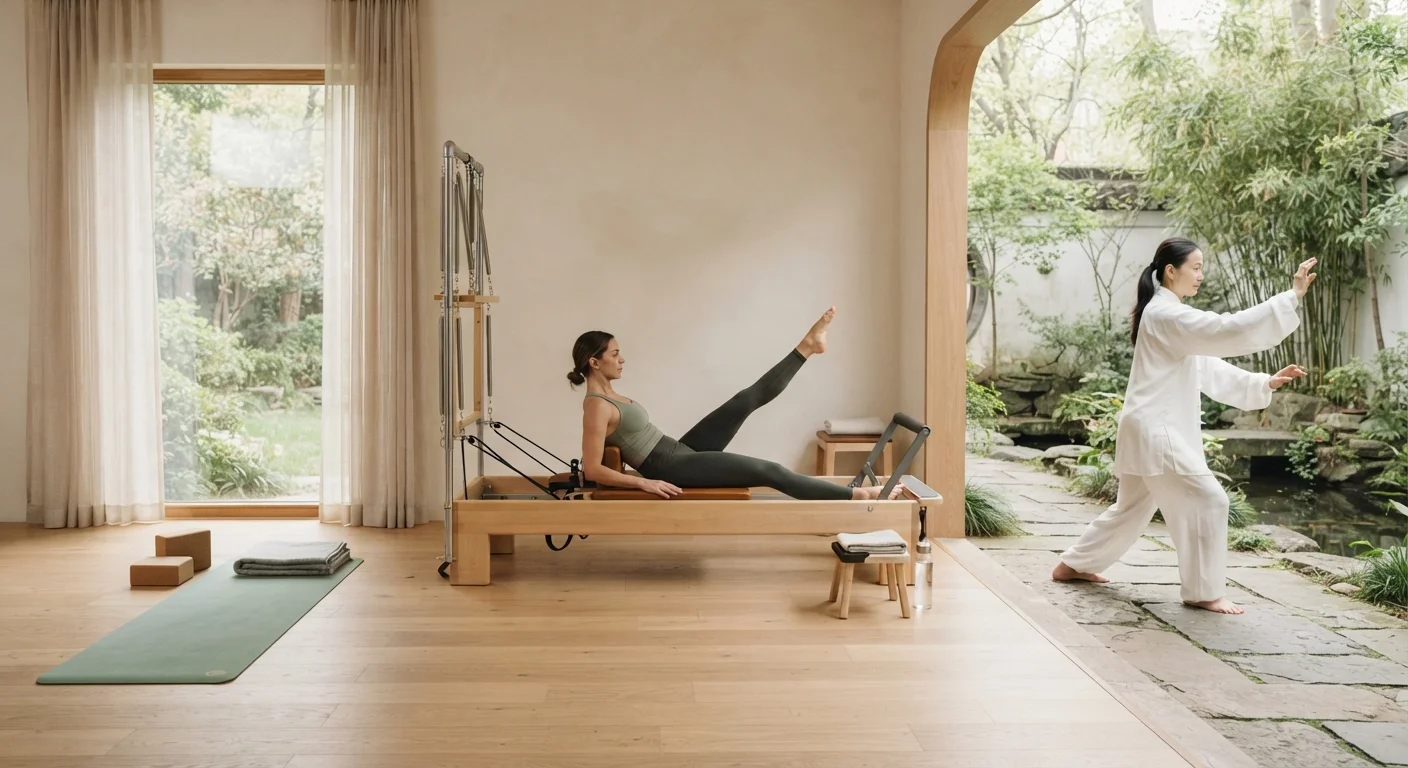
Pilates places the majority of its emphasis on the deep stabilizing muscles of the core - the transverse abdominis, pelvic floor, and muscles along the spine. Rather than training muscles in isolation, Pilates uses controlled, precise movements to develop neuromuscular coordination and postural support. Mat Pilates requires no equipment; reformer-based Pilates uses spring-loaded resistance and is often introduced through instructor-led sessions. It is widely used in physical therapy settings for low back rehabilitation.
Tai chi is often described as "meditation in motion." Practitioners move through a series of slow, linked postures in a continuous flow. The practice trains balance, proprioception (the body's sense of its own position in space), and coordination. The American College of Sports Medicine (ACSM) and other public health bodies have cited tai chi as a particularly effective intervention for fall prevention in older adults. Its calming, repetitive structure also supports nervous system regulation.
Try Before You Commit to One Style
All three practices vary considerably between instructors and class formats. A single beginner yoga session may feel very different from a Yin or Vinyasa class. Most studios and community centers offer introductory or drop-in sessions - sampling each style across two or three classes gives you a far more accurate sense of fit than reading descriptions alone. There's also no rule against practicing more than one: yoga and Pilates complement each other particularly well.
Practical Considerations: Accessibility, Setting, and Learning Curve
All three practices are genuinely beginner-friendly, but they differ in how and where you can start. Yoga has the widest availability - free online classes, community studios, and gym-based offerings make entry easy. Most beginners need only a mat and comfortable clothing.
Pilates mat work is similarly accessible at home with video instruction, though instructor-led sessions accelerate safe technique. Reformer Pilates typically requires studio access and guidance, which increases the initial cost and commitment. The precision Pilates demands means that poor form can reduce effectiveness - working with a qualified instructor early on is worthwhile.
Tai chi has the lowest equipment barrier of all three - it can be practiced in any open space, indoors or out. However, the choreographed sequences (called "forms") have a steeper memorization curve. Many beginners find group classes or community park sessions the easiest way in. For those weighing the social dimension of these practices, group versus solo training trade-offs is worth reviewing.
If you're looking to complement any of these disciplines with other gentle movement options, low-impact exercises that still deliver results offers practical starting points.
This article is for general informational purposes only and does not constitute medical advice. If you have existing health conditions, injuries, or concerns about starting a new exercise practice, please consult a qualified healthcare professional before beginning.