

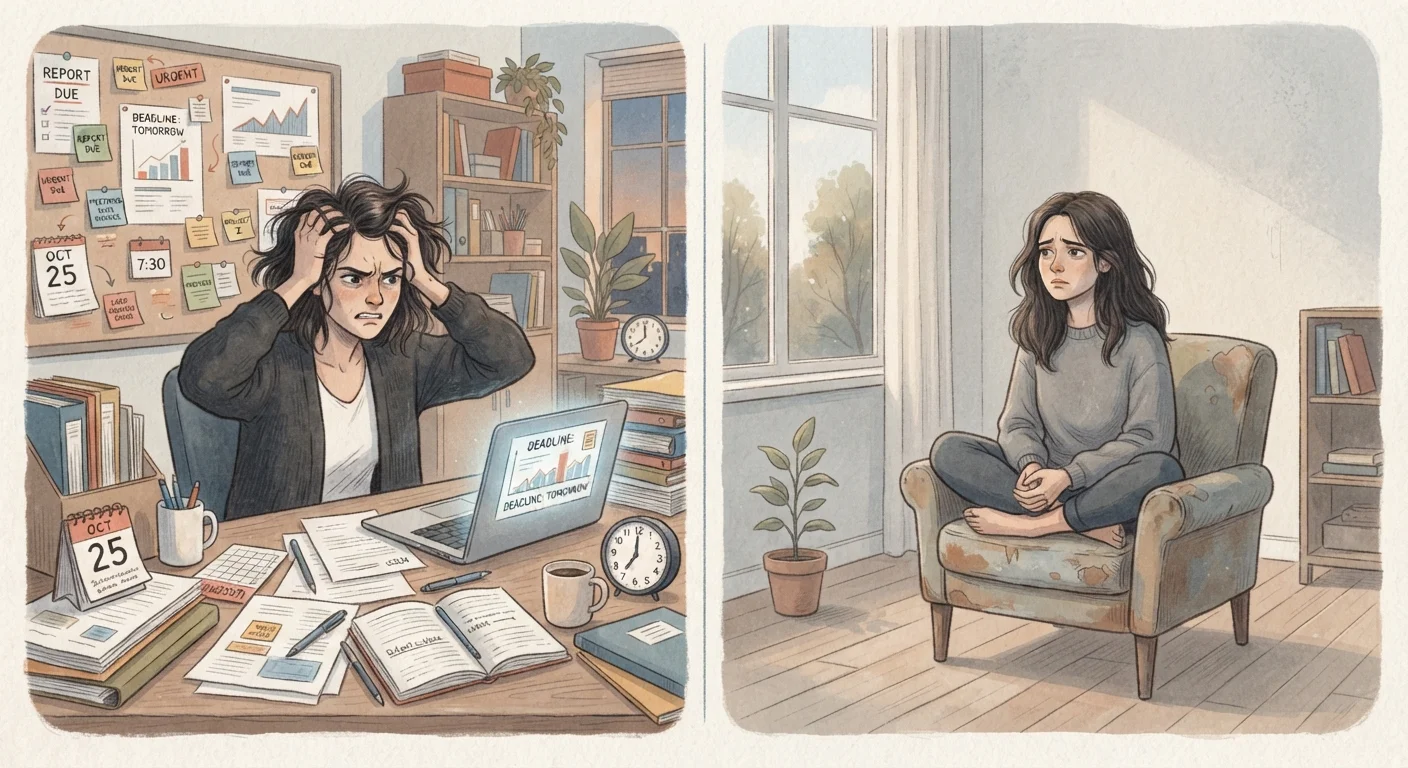
Key Takeaways
Option A
Everyday Stress
A normal, temporary response to identifiable pressure.
Best for: Understanding your body's natural reaction to deadlines, conflicts, or life changes — and how it usually resolves on its own.
Option B
Anxiety Disorder
A persistent pattern of worry that exceeds the situation and disrupts daily life.
Best for: Recognizing when worry has become disproportionate, ongoing, and in need of professional evaluation and support.
If your worry is tied to a specific event and fades once it resolves
Everyday Stress
This is a normal human response. Self-care strategies, rest, and time are usually sufficient for stress that has a clear source.
If worry persists for weeks without a clear trigger and disrupts daily life
Anxiety Disorder
Ongoing, disproportionate anxiety that affects functioning warrants a conversation with a qualified mental health professional.
If you're unsure whether what you're feeling is stress or something more serious
Anxiety Disorder
When in doubt, consult a healthcare provider. An assessment is low-risk and can rule out other causes while pointing you toward appropriate support.
What Is Everyday Stress — and What Makes It Normal?
Stress is your body's built-in alarm system. When you face a challenge — a tight deadline, a difficult conversation, a sudden change — your nervous system activates a fight-or-flight response, flooding your body with hormones like adrenaline and cortisol. Your heart rate rises, muscles tighten, and your focus sharpens. This is healthy and adaptive.
The defining feature of everyday stress is that it has a cause you can usually identify, and it eases when that cause is resolved. The pressure of an exam disappears after you hand it in. The tension before a difficult talk typically fades once the conversation is over. Stress is, by nature, situational.
That said, chronic stress — when stressors pile up without relief — can take a real toll. Prolonged activation of the body's stress response has been linked to sleep disruption, weakened immune function, and emotional exhaustion. Even when stress is understandable, it's worth addressing. Our complete guide to stress and anxiety walks through how both conditions affect your body and what you can do about them.
What Is an Anxiety Disorder — and How Is It Different?
Anxiety disorders are clinical conditions recognized by health authorities worldwide, including the American Psychiatric Association and the World Health Organization. They are among the most common mental health diagnoses globally. Unlike everyday stress, anxiety disorders are characterized by worry that is:
- Persistent — lasting weeks or months rather than days
- Disproportionate — the level of fear exceeds what the situation realistically warrants
- Hard to control — the person wants to stop worrying but finds it difficult
- Impairing — it interferes with work, relationships, sleep, or daily activities
Generalized Anxiety Disorder (GAD), for example, involves excessive worry about many different areas of life — health, finances, relationships — on most days for at least six months. Other types include panic disorder, social anxiety disorder, and specific phobias. Each has its own pattern, but all involve a worry response that is no longer proportional to real-world threat.
| Criterion | Everyday Stress | Anxiety Disorder |
|---|---|---|
| Trigger | Usually identifiable and specific | Often unclear or disproportionate |
| Duration | Resolves when stressor passes | Persists for weeks or months |
| Intensity | Proportional to the situation | Exceeds what the situation warrants |
| Control | Manageable with rest and coping skills | Difficult to control despite wanting to |
| Impact on daily life | Temporary disruption | Ongoing impairment to functioning |
| Physical symptoms | Tied to the stressful event | Can appear without a clear cause |
| Typical next step | Self-care, rest, lifestyle adjustments | Professional evaluation and treatment |
Anxiety disorders are not a sign of weakness or a character flaw. They involve real neurological and physiological processes and are highly treatable. If you recognize these patterns in yourself, your first steps toward managing anxiety can help you orient toward appropriate support.
Symptoms That Overlap — and Where They Differ
Both stress and anxiety share a range of physical and emotional symptoms, which is part of what makes them easy to confuse. Racing heart, shallow breathing, muscle tension, irritability, and difficulty concentrating can appear in both states.
Where they diverge is in duration, intensity, and trigger. Stress symptoms typically track the stressor — they rise and fall with it. Anxiety disorder symptoms can feel constant, unpredictable, and disconnected from any obvious event. Someone with an anxiety disorder may wake up already overwhelmed, with no clear reason why.
31%
Adults affected by anxiety disorder in their lifetime
According to the National Institute of Mental Health, approximately 31% of U.S. adults will experience an anxiety disorder at some point in their lives.
~40%
People with anxiety disorder who receive treatment
Research suggests that despite high prevalence, a significant proportion of people with anxiety disorders do not receive any treatment, according to data compiled by the Anxiety and Depression Association of America.
6 months
Minimum duration for GAD diagnosis
Clinical guidelines specify that Generalized Anxiety Disorder (GAD) is typically characterized by excessive worry occurring on most days for at least six months.
Another distinction worth noting: avoidance. People with anxiety disorders often begin organizing their lives around avoiding the things that trigger worry — declining social invitations, postponing medical appointments, or withdrawing from work responsibilities. This avoidance can quietly reinforce anxiety over time. Our article on coping patterns that can make anxiety worse explains this cycle in more detail.
This article is for general informational purposes only and is not a substitute for professional medical or mental health advice. If you are concerned about your mental health, please consult a qualified healthcare provider.
When to Seek Professional Support
A useful question to ask yourself is: "Has this worry stuck around even when the situation that started it has passed?" If the answer is yes — especially if it's been several weeks or more — that's worth exploring with a professional.
Other signals that suggest professional evaluation may be helpful include:
- Worry that feels impossible to switch off, even when you want to
- Physical symptoms like chest tightness or dizziness with no clear medical cause
- Avoiding people, places, or activities because of fear or worry
- Difficulty completing routine tasks due to anxious thoughts
- Sleep problems most nights that aren't explained by a temporary stressor
Not Sure Where to Start?
You don't need a diagnosis before reaching out for help. Many primary care physicians can conduct an initial mental health screening and refer you to appropriate support. If your symptoms feel urgent or you're struggling to cope day-to-day, contacting a mental health crisis line or going to an urgent care provider is a valid option. You deserve support regardless of whether your worry meets a clinical threshold.
Treatments for anxiety disorders — including cognitive behavioral therapy (CBT) and, where appropriate, medication evaluated by a physician — have a strong evidence base. Recovery is realistic for most people with the right support. If relaxation techniques have felt surprisingly uncomfortable for you, it may also be worth reading about why relaxation sometimes makes anxiety worse before assuming self-help tools alone are enough.
You don't need to have everything figured out before reaching out. A conversation with your primary care provider or a licensed mental health professional is always a reasonable starting point.